That #siesta van – conversion in progress, first to motor caravan for reclassification

Yes this has taken a while to update. Stuff happened – August is a VERY hot month in Spain, when life slows down and I was already not accomplishing much (or even attempting to, it is REALLY hot in August) when I suddenly sold my house and had to buy another and move within weeks: Things got really hectic and suddenly it was November and the MOT was expiring on 2nd December.

What I had learned in the meantime, which may help anyone looking at buying a right-hand-drive van to convert and use in Spain, is that it isn’t possible to get Spanish plates on a RHD van. What IS possible is to attempt to plate a RHD motor caravan. You have to have owned it at least six months, and it will still have to get through the Spanish test for roadworthiness (matriculación) (which will be very strict, because they really don’t want them here) to even be considered and because by definition it has a big engine, there’s a hefty chunk of duty to pay if it does, but it can be done.

Another thing for any British person with a Spanish driving licence to bear in mind is that even if you are still British by citizenship, Spanish only by residency, you are only allowed to drive a UK vehicle for a month in Spain before it must be plated. Slightly confusingly, the vehicle itself can be in Spain for up to six months before it must be matriculated.

So – the sensible thing to have done was to sell it back to the UK while it still had a few months on its MOT. However if you really think your van is worth a significant amount of trouble and expense, and your dogs love it, you can reclassify it and find an agent who specializes in plating UK vehicles and cross your fingers and go for it. I should have been sensible and this is not yet a success story and never may be, but it is a record of the next few steps.

I’m told the DVLA requirements may be changing soon but right now, at the time of this blog, the requirements to get your van reclassified as a motor caravan are actually not too challenging.

Externally, it must be recognisable immediately as a motor caravan, which effectively means it needs an awning rail either side, and suitable decals of your choice either side which declare it to be a recreation vehicle. This does remove the stealth option – where a van can park pretty much anywhere overnight and pretend to be empty, a motorhome can only park in appropriate places. The van must also be high enough for an adult to stand upright inside, and have at least two windows in the habitation area.

Internally, and as I mentioned this could be changing, it needs to have fixed seating in the habitation area, a fixed table which can be removed or adapted, and fitted sleeping arrangements, which can be converted from the seating / table. There must be at least a single-plate cooking facility built in, or microwave, and there must be storage facilities. Any gas supply must be correctly secured. Photographs showing all of the above, and the registration number, and the VIN or chassis number, must be sent to the DVLA along with the request for reclassification. They can, be warned, reclassify it as, say, a van with windows (and that decision is final) and / or they can insist it be presented at a suitable testing facility for inspection. This is all on the Gov.UK website – https://www.gov.uk/government/publications/converting-a-vehicle-into-a-motor-caravan/converting-a-vehicle-into-a-motor-caravan – and presumably the link stays the same if/when the requirements are revamped.

I took the van on a camping excursion during that first legal month and remained thrilled with it (we’d also had a successful trip from UK to ferry to Santander to home in the south of Spain) so I started on the conversion. It had to be stripped of some hoisting equipment (long story), the floor was sound but very scuffed, the previous owner had stripped out the ceiling insulation but the sides and doors had been professionally done and were still good. But tick tock – MOT running out 2nd December. The agent specializing in UK cars said he could get the van green-plated for up to six weeks, which would keep it legal long enough to reach the required six months of ownership (4th January) but it would have to be converted, reclassified, and the new V5 received, by then. DVLA was almost certain to demand an inspection seeing the MOT was imminent anyway, and as they frown on vehicles being taken out of the country ‘unofficially’ there could be no pleading that it was in Spain and an inspection would be seriously inconvenient.

As matters stand, the interior is largely completed to the “siesta van” minimums . The exterior requirements are not. The decision was, if it must be sold, to keep it in stealth mode until everything else had been done. In the UK, the only advantage to being reclassified is to be allowed to drive slightly faster on the motorway than is legal in a commercial van. Stealth mode is an asset to many, silly to lose it for what was still a very basic conversion.

Anyway, those are all fairly unique situations arising from owner stupidity so the only other thing this blog warns about is insurance. I got Spanish insurance from a broker specialising in English-speaking clients living in Spain but they are only the brokers. My advice would now be to get UK insurance for that first six months, which is what I had originally done with my car when I brought that to Spain. The van is on its way back to the UK with long-suffering friends to get its MOT sorted, but blotted its copybook very much indeed by dying in France. Untangling the situation with Spanish insurers and French garages is beyond frustration. Don’t do it. I’d also say in passing that if my brokers had only said (or even known) it wasn’t possible to register a RHD commercial vehicle in Spain this blog would never have been written and I wouldn’t have a dead van in France. This has been a series of stupid blunders from the beginning, though.

I can only say it seemed a good idea at the time. I drive a RHD car (legally) so am probably marginally less lethal in a RHD van than I would be in a LHD. I have a very young granddaughter in the UK so the notion of escaping the excessive summer heat every year by meandering across Europe with bag, baggage, dogs, and my own accommodation, to call on scattered family, was fatally tempting. Meh.

There’s no law that says you have to make your own mistakes, you can learn instead from others, so there may well be more blogs on the nature of this rather focused ignorance for any other unenlightened out there.

Adios to the Casa Excéntrico

Today in Alcampo I saw breakfast bars on special and thought ooh, good, a chance to stock up. I always stock at least 4 types of breakfast bars for guests, in case they get the munchies before they can get to the shops and stock up.

I’m beginning to wonder how long it will take before that automatic reflex disappears. I don’t need to buy loo rolls in bulk anymore. I don’t need six-packs of long-life milk (I drink fresh) or 12 packs of bottled water (I drink filtered) and I can walk past the special offers on bedlinen or towels, because I’m no longer in the hosting business and never again need to wonder what on earth was in the hair oil which permanently stained a pillowslip and put an entire set of guest linen off the usable list. Guests – hungry, thirsty, oily, infuriating or delightful – are literally no longer my business. The Casa Excéntrico has been sold, this month, eight years after I bought it in October 2017, and I thought I had completely come to grips with that until I found myself chucking breakfast bars into my shopping cart.

I’ve just deleted the Casa tab off this website. I wanted to hide it, get used to the idea, but the only option to lose the tab was ‘trash’. Ouch. The last eight years owning a small guesthouse – two guest suites, a shared guest kitchen – has been a fair chunk of my life. I’ll miss the income, I’ll miss some, most, of the guests – fun, zany, eccentric, charming, shy, borderline bonkers, hilarious, lonely, gregarious, adventurous – or recovering from life giving them a sharp smack up the head. The sour, greedy, or uneasily alarming, ones, I won’t miss, but they were very much in the minority. Many were house-hunting in the general area, and some who bought locally became genuine friends. I promoted the house as quirky, a bit peculiar, because frankly it was, and as a result nearly everyone who stayed embraced its oddities.

Twice the atrium and hallway were flooded by heavy rains – the first time, I heard my French guest running down the stairs as I struggled to slosh ankle-deep floodwater up the slight slope out of the hallway towards the drain and thought ‘complain all you like, mate, I don’t control the weather.’ Instead he seized the other heavy yard brush and wordlessly helped – his English was even worse than my French. Many of my guests were Spanish, back to visit family for special occasions, and out nearly all the time as a result. Very few of the rest were English, since when the English come to Spain on holiday they either take a villa or want to be walking distance from the beaches and not have to drive on the ‘wrong’ side of the road. Instead I had Americans wanting to explore ‘real’ Spain, and Canadians, Scottish, Irish, French, German, Egyptian, Vietnamese, Czech, Polish, Estonian, Swiss, the full range of Scandis, Italian, quite a few South Americans. Lots with pets, none with small children unless I was personally related to them. I didn’t ask a lot, since I couldn’t offer a lot (my listing said in large letters, no pool, no aircon, no TV) so guests tended to be young, or generally on a tight budget. Many were travelling alone, some very self-contained, some bursting to chat about the events of each day. They were hikers, cyclists, bikers, writers, students, house-hunters, explorers, restless or recuperating. My very first guest was Danish, 30-something, very good-looking, working on his Masters thesis, and asked diffidently if I’d ‘introduce’ him to the nearest bar. The older woman who’d sold me the house entered the bar a few minutes after we sat down, looked at him with huge interest, then leered approvingly at me. Neither she nor anyone else believed there would ever be any ‘real’ guests, that the house could possibly succeed, but then I never expected to live on its income, I asked only that it supported itself – paid its own overheads and, so far as possible, its own ongoing maintenance, and it did. The pandemic was tough, but as soon as any guests at all were allowed, I could advertise that they would be the only ones at any one time. As lockdown lifted, stage by stage, I had my busiest year to date. There were, over the years, several hundred guests and I kept detailed notes on every one. At first I thought of that as research, maybe a book in it, but some were definitely stranger than fiction.

I won’t miss trudging up and down those stairs with their high risers, or the cleaning, or ironing guest linen. I certainly won’t miss the few crappy guests – one bad guest effortlessly outweighs ten, twenty, lovely ones. The buyers are Spanish, and will continue to run it as a guesthouse, I suspect rather more efficiently and luxuriously than I did. They’re significantly younger, so have much more energy and more enthusiasm than I can drum up, these days. I have no idea if they will play up its eccentricity, as I did, but you know what, if you get a chance to stay there, do let me know how you got on. I’m settling comfortably into my little house (in its own ways, just as quirky, I think it must be me) but I’ll miss the Casa Excéntrico for a while yet. In its own quiet way, it was a great adventure.

(Two listings, this was for the front room)

The #siesta van

Back in 2017 I needed to get from Scotland to Spain, with boxes and pets. Camperhomes, even before the popularity surge caused by Covid, were alarmingly expensive. I chased up a cheap van in Glasgow because I couldn’t understand how it could be so, well, cheap. The seller described it as a day van, a bit apologetically. I looked blank and he said well, a weekend van. Or an event van. He took his, he said, to dog shows.  You couldn’t LIVE in it.  

I did, for 8 weeks, but because I was travelling alone I was staying at campsites anyway: loos, showers, and washing machines were part of the campsite package and so far as transporting me and my pets and several boxes of needed-on-voyage stuff went, it was perfect. I miss it so much that I started looking for another this year. Day van is not a known description in Spain (not that well known in the UK, for that matter) but although they have lots of the type, there’s no other name, either.  I tutted at myself and tried siesta van, which seemed the obvious Spanish name. Nope.

We’re talking about a van without built-in plumbing, really, although the definition is fairly fluid. It has a bed, and a fridge, those are important, and a leisure battery with at least one plug point. Talking of plug points, it should link to campsite (or dog show) electricity points, then you aren’t relying solely on the leisure battery. Cooking facilities are usually camping type. A porta-potty – maybe even a mini sink with a foot-pump and bottles of water  (well, mine did) but not a shower.  Not a lot of fancy. “Siesta van” works for me. Time to get the name out there, to help me search …

Insulation would be a definite plus, on my check list. Having windows, big yes, and a skylight, bonus.  I can source my own portable toilet if there isn’t one. Adding a sink and hot water and a water pump, yes worth having – eventually if not immediately. But basically a van that supports your hobbies, and interests, keeps you comfortable and secure, gets you there and back, has a little comfort for excursions.  

Don’t get me wrong, not dissing those motorhomes which cost more than a holiday apartment – what can be fitted into those is eye-popping, if sometimes a little cramped. The features you get! The price you pay!

·         I don’t need solar panels and storage batteries and inverters and fancy dials to monitor them, because I won’t be going off-grid more than my leisure battery can handle.

·          I don’t want a shower. I love showering, the longer the better, but to meet my shower needs a van (or motorhome) would have to drag its own water tanker around.  Most on-grid campers I’ve spoken to don’t use theirs – they’d rather grab their flip-flops and go use campsite ones, or gym ones, for exactly that reason. So the fab shower which pushed their camper price up by thousands is often just a fancy cupboard, or a place to hang wet clothes.  

·         The ability to sleep several people of differing sizes, don’t need that.     

·         Enough storage to have every season’s wardrobe on tap, well, uh, no. I go home between excursions.

Paying for those, if you need them, no-brainer. But perhaps you, like me, only need a bed. And blackout blinds. And room to store a bit of food, and some changes of clothes. A 3 way fridge – nothing worse than waking up all hot after a siesta and nothing cold to drink.  We’re not living off grid for six months at a time, it can be pretty simple. I don’t personally need a bike rack, or to store surf-boards, but some vans have them. They’ve got the space – because they didn’t  waste space on a shower –  

I thought I’d found just the job, but I found it in the UK and brought it to Spain and, well, that’s causing issues. I’ll probably blog a bit about the learning curve because then maybe people will chip in with ideas of the must-have features for the perfect, ideal, budget-friendly, siesta van. Deal?

Fostering rescued dogs, especially ones with special needs – yes / no? #OneYearOn #Spain

I was actually a bit shocked when I posted on Facebook about my two new fosters in June 2024 and a friend praised them and said she followed a group for failed fosters. What? Letting the dogs down? And of course as everyone but me knew, failure is being unable to give them up and keeping them and is a Good Thing.

I’d lost a dog I loved very much before she’d even had the chance to slow down and grow old and prepare me for her going, when  I’d always thought she’d be my last dog.  I was even casting around for ways of securing her future if I pre-deceased her.  This rambling eccentric old house was suddenly echoingly empty and it was unbearable. I decided that long-term I’d adopt an older dog but for the interim I would do emergency short-term fosters, a kind of payback for the years of love and company from the three rescue dogs I’d serially owned.  For a couple of months, I said.

In the last year there have been six, two still with me. This blog is really for anyone thinking along the same lines, perhaps for similar reasons. Would I do it again? Should you do it? Aren’t rescue dogs from traumatic backgrounds half-crazed with fear and distrust? Don’t foster dogs get too attached (and you to them) to ever be given up? Isn’t it heart-breaking to hand over a dog that’s lived with you for months?

For starters, the choice is very nearly endless, especially in Spain where unwanted dogs in good health can by law no longer be put to sleep. Municipal pounds are crammed, rescue shelters are at capacity, charities at full stretch financially, and anyone prepared to help a dog through the transition from trauma to normality, ready for homing, can refuse dogs they think too big, too small, too wild, too damaged, too much, and still there are dozens, hundreds, to choose from. The safest are often older and have been abruptly orphaned , plunged into crowded cages and runs after a lifetime of privileged home life, until a new permanent home can be found, and you are offering only shelter and peace. You can leave the really challenging ones for experts and still change a dog’s life from despair to relief.  Emotionally – it’s not unlike having visitors. You know they aren’t there forever, so you enjoy the time together very much and yes, miss the company when they go to a permanent place, but it isn’t devastating. There are tears, or there were for me, but not heartbreak.  The ones with special needs – it is indescribable how it feels to help a dog through despair to trusting human beings again, ready to join a family of its very own.

Fostered dogs are owned by the charity that rescued them and the usual arrangement is that the charity covers vet bills and unexpected expenses, has absolute final say on any adoption arrangements, and will instantly take the dog back at any point if your circumstances change. If special diet or training is required, some charities offer more support. “Residencies” charge a monthly rate for keeping dogs in semi-confined conditions, giving them any medication necessary, and letting them slowly acclimatise.

I’ve had dogs from, or via, Valle Verde and Give A Dog A Home (GADAH) Malaga, and two from a charity which had to close (due to lack of funds rather than love of dogs and passion for their well-being). That’s an ongoing problem – so very many dogs (and cats) and so little money, so few homes.   

I’ve said never again twice, (because of the tears, not because of bad experiences) then done it again, twice. I do think both my current ones are failed fosters, though. They are part of the fabric of my life now.  Agoraphobic Kim – well, look at him now. He will probably always be shy.

Did that answer your questions?  The rest is a self-indulgent memory-fest for the six fosters who have shared my life in the last year. All have had unique stories, not all traumatic.

Kim’s been around a year and celebrated his anniversary with a mini hike in the morning with his current foster sister AND  a former foster sister, now adopted locally and extremely happy. We went out socially in the afternoon to a café to catch up with friends, and his anniversary supper included roast pork, something to which he is very partial. Not bad for a dog who took weeks to be coaxed out of determined self-imposed exile in the laundry, months to go out the front door on his first walk, who fled in terror when anyone entered the house,  and literally crapped himself if they followed him to his bed. Progress has been slow but steady. Last weekend  he and Carina came away on holiday with me to escape the local fiesta, which is heavy on fireworks and recreation of historic medieval warfare (moros y cristianos, muskets and swords and marching bands, huge fun unless you’re a nervous dog) and there were all sorts of challenges to face. Entering a strange house – charging about  off-lead in a totally strange place in the middle of nowhere (no fences, just miles and miles of rural Spain) – new routines. He loved it. By the second day he was going into the house under his own steam (ok, diving straight under the table and staying there, he’s still Kim), by the third, he was doing his own very special dance of welcome when our host emerged outside with cups of coffee. Neither dog went far without me but both begged for constant walks when we went outside. He’d vanish into the distance, appearing in under a minute when I turned back. He’s still to bark at home when the doorbell rings (at least he no longer disappears at speed into the safety of the bedroom) but on holiday he growled and barked at a distant dog which decided not to investigate after all.

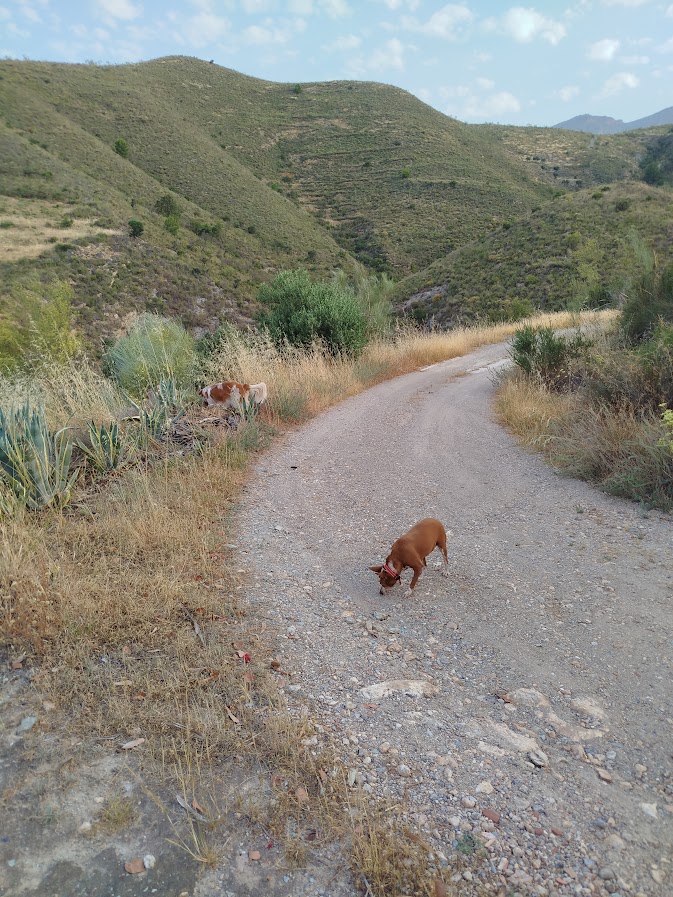
Kim and Carina exploring in the campo

Carina

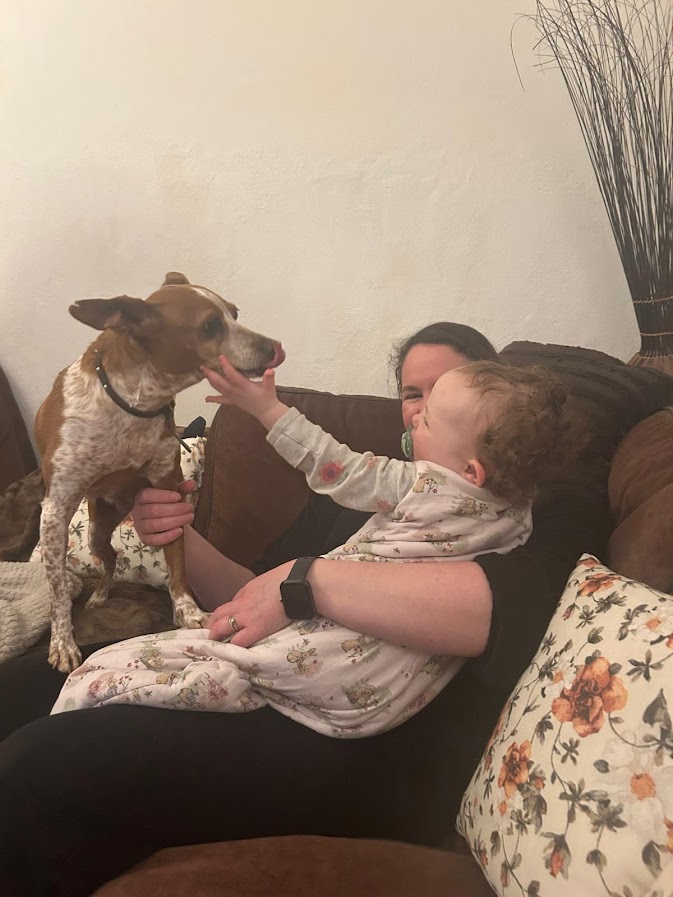
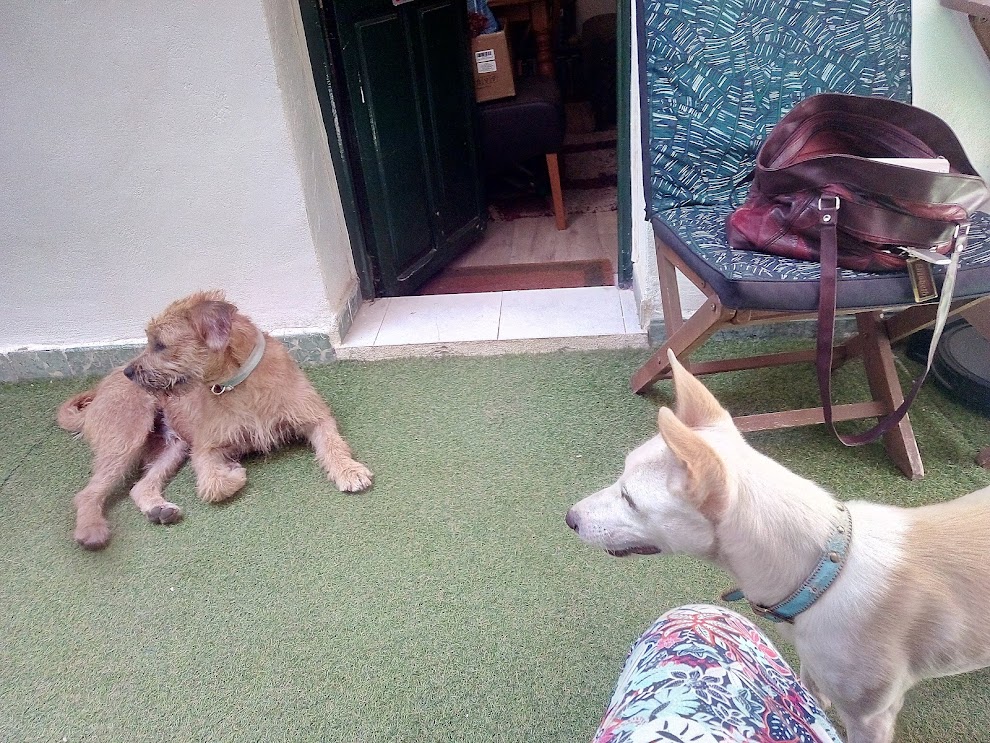
Carina is the sixth foster, a very dainty older podencohuahua (there’s a big dollop of Chihuahua in there) who has been  here a couple of months and is permanently joyful, putting aside her fairly horrible past and focusing only on the here-and-now, always up for the adventures of the day. Even when they are as mundane as housework or taking rubbish to the big street bins, she’s in.  Her huge maimed ears are up at the faintest sound, her tail permanently ready to wag, and she adored, and was adored by, my visiting toddler granddaughter.

Carina meets a human her very own size

She enjoys company generally but a human her own size delighted her. She’s very special, very ready to go to a forever home, and yet the thought of her going . . . well, there are tears every time one goes to their own forever home, but Carina and Kim between them have become perfect companions. We’re all reddish and freckled, all three tolerant of our very separate ways, all rubbing along together. I’ve been spoiled by Blanquita (now Chica) finding her happy home just around the corner and meeting her often, so a perfect home for Carina would have to be local, and loving, and special.

Leia – the first foster

Leia, the very first foster (by 2 days) of them all, rescued from a horrible existence in a cage with rare visits from an indifferent owner (who should be stuck in a cage for a year too, fed twice a week, but hey, just my opinion) went to the wrong owner first and that was devastating, but then found the place perfect for her and is utterly happy now, living her best life.

Dobby and Leia

Dobby, adopted from a pound, was only ever on loan while his owner was recovering from some bad luck, and I follow his adventures on Facebook, and he’s grand, hiking socially several times a week for amazing distances, and loving his life. A super dog who took both Leia and Kim in hand and coached them in being dogs.

Bonnie on the day she left and became Mia

Bonnie, a Breton spaniel who was formerly briefly Prima and is now Mia, was Kim’s favourite – he’s half Breton spaniel (a Breton Collie, we call him) and worshipped her from day one, following her about like a puppy (he and Carina get on, but are not inseparable).  She wasn’t a horror story – handed in by her hunter owner when she slowed down, just needing to adapt to living in a home, which she did effortlessly. We get occasional updates via WhatsApp about Mia  – she’s I think the oldest of the lot but enjoys a happy active life living a few hours away with another rescued Breton spaniel and photos are usually of her looking smug on the sofa.  I deliberately chose this one of her leaving for her new life – there was no distress.

Blanquita and Kim preferred to share in cold weather

I said at that point no more fosters, too many tears when they left, but Blanquita, a podenco maneto dumped at a petrol station, living wild for a year while she waited for her faithless owners to return, fed by the kind staff at the petrol station shop but refusing to be caught, was an emergency after she was attacked by a pack of hunting dogs and badly injured. Kim took an active part in her recuperation and reintroduction to normality, even gulping down his fear to go on walks to encourage her, gentle and protective. She became Chica and they are always delighted to see each other – she visits if her owners have to leave her alone for longer periods, and she and Carina play while Kim watches benignly.  

Chica visiting Carina and Kim – treats? Really? Ooh

Six special dogs. No regrets.

Carina, Bonnie and Kim, Dobby, oops (Dobby teaching Leia to play), Kim, Blanquita, Leia

Musing about relationships between the well-matured. Well, no change there then. And a quick catch-up.

I’m in the throes of creating a blogger who actually makes money from blogging – what a novel idea – and it did remind me I’ve not updated here for a goodish while. Oops. Between running holiday rentals upstairs through a growing minefield of official Spanish bureaucracy, wondering whether I’ll be getting a sixth foster dog (not six at once! I’m currently left with one, the ubiquitous Kim), still teaching English in twenty-two countries around the world, and idly planning huge changes for the next ten years while knowing everything could go tits up tomorrow, I’ve been busy. Life in Spain. Love it. 

 I’ve also been writing, of course, always, my happy place. Every book ever written has, or in my opinion should have, at least ten percent experience to be credible, a lot of research to be worth reading, and a massive dollop of imagination to be enjoyable. As a writer one does sometimes get bogged down in the research, or fall short on the imagination. Still, that’s why the title is about musing, because there is a lot needed for the current book. The challenge is not only the plot, and the setting, and a satisfactory conclusion, but drawing an angry obsessive man and a vague stubborn woman beyond social necessity, when life throws them together (inevitably, murder is the catalyst) into something that readers will root for – a non-relationship that works. Watch this space. 

Yup, non-relationship. After all these years of banging on about mature singles getting together. Thing is I’m one of the ever-increasing demographic of women who face they like men but not enough to live with one. Likely to live out my life solo, not generally too dismayed about it. IF the perfect man happened along, AND thought I was the perfect woman, yin to his yang, that would be very interesting indeed but the odds are pretty much a million to one. I am however enduringly fascinated by the way people, even the most extraordinarily mismatched people, can create working relationships, however unconventional some are, from a shared past which has changed its parameters, or from scratch. I’ve had a few. Some could have gone fulltime – decided against, instead wove what could have been into a book. Write what you know. But readers like happy endings, right? So the rest of this very long blog is all about musing and unless you’re older and single and also musing about the future you can go now, and thanks for popping by, take care xx 

Living in a largely ex-pat community made up of couples and singles, one becomes very aware that marriages which change after years of togetherness – such as retirement, planned early or involuntary, throwing couples together full-time – have new challenges, even for those who have decades together, and still have the rest of the road to travel. They are used to each other, certainly. Used to being exasperated by each other, too, but know what to expect, recognise each other’s moods and impulses, know how to irritate the hell out of each other but also how to make peace again. 

Starting over after fifty, after sixty, with someone new who is more than halfway through life, is way harder than it was thirty years earlier even though more people are marrying in the autumn of their lives than has ever happened before. Not for the same reasons – no babies, for starters, because we’re not talking about May December marriages, we’re talking both being at the very least September, sometimes October, often later. Well, there is ONE reason shared with May / December marriages. Money is usually a factor. None of our autumn lovers have vast amounts of it, as a rule. More a case of sharing resources, deciding which nest to sell and which to share. Shared pensions, for the already retired, will stretch a little further than one each. There’s company, too. Family has shrunk, and former offspring are busy with their own lives. Friends have moved or died or changed beyond what is comfortable. Health and mobility might start becoming an issue and unlucky the couple both having issues at the same time – normally they’ll be able to support each other through that. Take turns, almost. 

Don’t get me wrong, these are not the reasons foremost in the autumnal couple’s mind (apart from those determined to marry for financial security), but they are factors which simply don’t occur to spring couples. When you are alone, at any age, and meet someone congenial who fancies you, at any age, the rush is the rush. The sap rises, you are delighted, you bounce as you walk, your eyes brighten and the world is bathed in sudden colour. But new autumnal couples (whether alone for a while or suddenly facing life alone after years in relationships which have ended) find the biggest issue they have to face is compromise. LOTS of compromise. On so very many levels! He likes going to bed straight after the news, she is happiest nodding off in front of the telly and only heading to bed after waking up to go to the loo at two in the morning – or the other way round. Established couples take that in their stride as it evolves over the years. New couples have to get used to it. 

 As to what telly they both like to watch – don’t even go there. Control of the remote is one of the perks of being single. 

They both snore, that’s pretty much a given after middle age, so it’s a race to get to sleep first or lie awake resenting the winner. If the shared nest has two rooms, phew. Otherwise – an issue, until deafness comes to the rescue.

One of them may drink more, much more, than the other. One may even smoke, although that’s rarer the older both are. Chances are rare both are on the same page re social life, too. Each other’s friends …

Food? You practically need two fridges, and half the time would rather be eating different meals, or cooked different ways. He likes his steak blue and she likes hers indistinguishable from shoe leather. She likes long walks along the beach, he’s far happier pottering in the garden or little building projects – or, always in these examples, the other way round. She may have a cat and he a dog and they, too, have to share the new set up in uneasy détente. Some couples do get together simply to stave off a lonely future pinching pennies, on the sensible foundation of shared friends, shared habits, similar lifestyles, and they make it work, but make no mistake, tolerance, compromise, and more compromise, is their glue no matter how similar they are. 

 Of course this applies to friends too, we’ve all found that, there are subjects that we both accept are off the table even with friends who go back forever, like politics, or religion, or the books they like and you thought were trite, or pretentious, or so worthy as to be unbearably depressing. Still, you can restrict your time with friends, enjoy their company very much within those careful parameters, then go your separate ways until arranging the next meeting.

Older types who choose to extend this into going home together and considerately picking their way through the potential minefields 24/7 for the rest of their lives – not as easy as you’d think. The young have make-up sex to smooth over many of the cracks. The older you get, the less of a patch sex offers. For starters, half the time you’re having to stop to massage unexpected agonising cramps, or there are false starts, plus it simply doesn’t happen as often. Affection, hugs, shoulder rubs, light kisses, can become issues of their own. To some they are only ever a prelude to seduction so why bother if seduction isn’t on the table. When you’ve lived alone for a while, a spontaneous hug out of the blue from your new companion is delightful but why? What’s the agenda? What do you want? So the happiest couples are those who share displays of affection constantly, without agenda, but that’s a new habit to be built and maintained and when both have been single a while, it doesn’t come effortlessly. Yet to give up on something pretty good because they don’t tick every box . . . there’s a trend towards permanent relationships which aren’t full-time, not even romantic, but a bit more than friendship. 

 I wrote a series of whodunits (Grasshopper Lawns, links in the side bar, they’re absolutely brilliant, try one  😊) featuring four older protagonists who did achieve all the compromises necessary for ongoing unconventional relationships, and I have left them to get on with their lives before the inevitable onset of age presents challenges – failing hearing, failing eyesight, losing faculties, the rising inevitability of health issues. Nobody enjoys perfect health forever. They should make it, they’ve got each other for strong support and will cope. My other books have explored other characters getting close, soppy old romantic that I am. But now I’m thinking through a different, mismatched, sort of relationship, one that is non-romantic yet works, and it takes a lot of musing.  

Still here? GREAT! Any thoughts on the topic in the comments would be awesome! 

Fostering dogs diary – 2

Still fostering … the turnover is going well, the fourth dog arrived a week ago, and now I know why people do it again and again, how the satisfaction and accomplishment makes up for the series of goodbyes.

Patience and kindness and routine and time – some need more time than others. In my case I had planned to do it for the sizzling hot Spanish summer, when so many of the expats in our social circle would be away, the house was closed to guests, and it would be lonely as hell with only Purdey’s fading memory for company. I offered to take dogs in urgent, temporary, need from both GADAH and Valle Verde. Selfish, oh yes, but in mitigation, benefit for the dogs – win win.  There are so MANY dogs needing temporary refuge in a home environment that one can choose where to help. Owners die unexpectedly, and the bereaved dog spirals into depression in a pound while a new home is sought.  Dogs are found injured, are patched up, and then need convalescence time outside the bustle and chaos of shelters. Working dogs which can no longer work and need to learn a whole new way of life. Dogs dumped because the owners want to go away for the summer, which have to accept their lives have changed, their families gone forever. Young dogs growing inconveniently bigger than expected, adored as puppies, suddenly unwanted, and needing confidence restored. Not every home suits every foster need, that would be impossible. You choose the ones where you can help.  Some rescue dogs have been badly bruised by life, they need time to adjust, and don’t always bond immediately, so they are not heartbroken by another goodbye, instead readied to make their next home the one that counts. Having said that, my most recent is bonding like glue! It usually, rule of thumb, takes 3 days for a dog to settle, 3 weeks to adjust to the new way of life, 3 months to bond completely. Short fosters don’t usually affect a dog’s heart, but reshape its attitude to life. 

As for fostering vs adopting – many of those wanting to adopt want a pet which will fit into their lives smoothly and easily, at the very least want to know what issues they will be resolving. Adopting a dog, THEN learning it is tricky with cats, or tries to bolt on walks, or hides under the bed, or is aggressive through fear – those are the failure stories which make people anxious about taking an unknown rescue dog straight from a shelter. Fostering can change that completely. One learns the animal’s fears, then gives them the breathing space to adjust, and when they do go to forever homes the adopting family knows exactly what to expect and what is needed to turn their anxious new companion into a loving confident friend . . . there is no dog more appreciative than one which has lost everything, and gets a second chance. Rescue pets are the most loving of all, once they dare to trust again, and fostering plays an important role in restoring trust in the human race.   

Leia at ease in her new home – when she first arrived here, she was afraid to come indoors.

So the summer, the worst of the heat, is now over and my fostering diary continues after all  . . . Kim the Breton is still here and will be for the foreseeable future. His progress is slow but steady and he is now positively joyful in the mornings, delighted greetings when I wake up, capering around as we prep for going out. The wheels then do fall off a bit, he tends to pee triumphantly (reclaiming the immediate surroundings) then dash back home, and if there’s anyone in the street (it is a street, after all) there’s a bit of a meltdown and he’s bolting back all a-quiver. Still, he now ambles about the house shyly and spends more time in the study than brooding in the laundry or bedroom.  He spent weeks lurking in the laundry trying to be invisible, great credit goes to the cheerful confident Dobby who is a true success story. He spent nine months growing up in a pound, went into foster, was adopted almost immediately by his foster mum because he is an absolute darling, then stayed here for a month while she recovered from an (unrelated!) broken shoulder.

Dobby being eyed

cautiously by Leia

 Dobby did wonders for Leia, who had never learned to play or really even socialise before he breezed in, and she blossomed almost immediately. She left for her forever home (where she is settling very happily, after her horrific start in life) two weeks after his arrival and he turned his attention full-time to Kim. They’d both done porridge at the same pound, overlapping by a few months, and although Kim simply wouldn’t play he did slowly pick up some of Dobby’s enthusiasm for life.  He coped well when Dobby left, no regression, but no more progress, so Bonnie moved in a week ago. 

She’s the real-deal Breton, longer ears, no tail, noticeably smaller than he is, very similar colouring, and he adores her. She is believed to around seven and was handed into the pound by her hunter owner with another Breton girl who is now also in foster care. She is unused to town life, or living indoors, but has embraced it all with aplomb and enthusiasm. She’s finding it difficult to adjust to walks on a lead, eyes pigeons with mild interest (although Bretons are used in Spain for songbirds, pigeons are the only birds she sees here) and keeps expecting me to put her to work – she hasn’t entirely grasped that her job is now to teach Kim to be happy and confident.  Within two days he was so keen to show off to her he was finally out the front door, eleven weeks after his arrival, and he follows her around as much as she will permit. As she follows me around a lot of the time, we move about the house in procession.  Taking photos is difficult because she likes to be close . . .

I post a lot on Facebook about the dogs so this blog is more talking generally about the fostering experience, changing a dog’s life as it did with Leia and is slowly doing with Kim. Bonnie, having retired from hunting, is learning to be a house dog in a small town. Dobby was an exuberant treat to have around.  For anyone who lost a much-loved dog, as I did, fostering is an interim measure which heals the bruised hearts of both parties. 

To those who say they couldn’t face caring for a dog they’d have to give up, yes. I did cry when Leia went, but I knew she was going on to a happy caring home and I’d played a real role in her ability to be adopted. Yes, I cried when Dobby had to go back! But you know what, nothing like the wrenching tears of grief. Fostering made a difference in all our lives, and that seemed to be worth blogging about.

So I did.

Decree 31/2024 Turismo

Decree 31/2024 is nineteen pages in Spanish relating to changes in the control and administration of tourism, which is booming as never before, specifically to regulate the accommodation of tourists heading to registered and new hosts. It was published on 22nd January 2024, and comes into full effect on 22nd January 2025. My usual readers can skip this blog entirely.

The Decree, unlike earlier ones, does take a sharp look at rural hosts – rural being defined (elsewhere online, hopefully accurately) as municipalities with fewer than ten thousand people.

Some of us hosts in small towns or out in the campo missed the news and have missed the six month deadline for some options, which was on 22nd August. Although the decree also covers non-resident owners renting out holiday properties I couldn’t find an English translation, so I put it through an online translator with – we’ve all been there – erratic results. This is therefore certainly not guaranteed to be fully accurate or even comprehensive – more than once numbers skipped, or were out of sequence, and I too skipped over bits which quite obviously referred to hotels or agents handling multiple properties – but if you too are a host and suddenly hearing rumours of having to upgrade to a five star standard or lose your licence, I picked out twenty points of potential interest. Some were the source of the rumours, a couple are new, a few modified, others are common sense and reiterated. I do appreciate this is quite a niche blog.

Bottom line, if your municipality doesn’t want you around you could be in trouble. For the rest – not quite as scary as I thought. Unless Google Translate missed something really terrifying.   

1.     The main change, and covered in exhaustive detail – control, or more control, is now given to the local municipalities, to ensure tourist accommodation is compatible or complementary to the municipality.

2.     A major change – agents operating the property on behalf of the owner(s) must, regardless of the title enabling them to do so, appear as owners of the operation in the responsible declaration referred to in article 9 of this decree. Anyone handling more than two separate properties is affected.

3.     In brief, private properties let out in their entirety cannot offer more than 15 places. There must be 2 bathrooms if more than 5 guests, and 3 bathrooms if more than 8 guests. However if your villa sleeps up to 15 people this article is not going to be of much use and you need to read the decree itself. (Niche. Yup.)   

4.     This blog is primarily for the smaller-scale host, registered, paying their taxes, advertising through the holiday websites, and offering rooms or suites on their property. If you notice a vital omission please add it to the comments! We are in a sub-section all our own, sink or swim together . . .

5.     Those renting parts of their own premises cannot offer more than 6 rooms (without entering a different category) and each room cannot sleep more than four people. Two must be in beds that are not bunk beds. Two convertible beds will be allowed in the living room, counting towards the maximum capacity of the dwelling. The owner of the property must be resident on the property.

6.     The minimum space which can be offered to tourists is 25 m² with a minimum of 14 m² per guest. My understanding is this does not require bedrooms larger than the average master bedroom, rather can be calculated on the total space dedicated to the guest(s).

7.     Bedrooms and living rooms – this is not a new requirement – must have direct ventilation to the outside or to ventilated patios and some kind of window darkening system (unless the building is protected and can be exempt for architectural or historical reasons). Equally, cave-type constructions are allowed but must comply with territorial and urban planning regulations, for both this and the next point.

8.     Kitchens and bathrooms must have direct or forced ventilation for air renewal.

9.     That airconditioning issue – the decree specifies it must be provided from May to August, but can be fixed or portable units. Equally, “centralized or non-centralized heating by fixed or portable elements in the bedrooms and living rooms, if the period of operation includes the months of December, January, February and March, without incandescent elements or combustion of flammable liquids or gases being admissible under any circumstances”.  Fires out, gas heaters out, radiators or electric heaters in.  

10.  Hosts must provide users with a 24-hour telephone number to immediately answer and resolve any queries or incidents relating to the home. There were rumours a phone must be supplied in each room. Yes if you are a hotel and guests need to reach Reception. Otherwise nope. Just keep your mobile phone with you 24/7.

11.  Clean the room(s) when guests move in and out. Well, duh. Have official Complaint and Claim Forms from the Andalusian Government available to users and a sign announcing them in a visible place inside the home. Well, that’s not new either, I had to get them in a hurry after my 2019 inspection. They can be ordered online even from Amazon.es – the correct forms, specific to Turismo requirements.

12.  Notifications should be clear re the rules of coexistence, restricted areas, and shared facilities. Not sure if this is new but common sense anyway. Factors such as the admission (and / or existence) of pets in the dwelling, restrictions re smoking, garbage disposal, guidelines re noise, vibrations, etc., required environmentally and municipally should be clearly established. In an apartment block any evacuation plan must be posted on the door of the dwelling. The decree confirms, further on, these regulations should be in at least Spanish and English, other languages optional.   

13.  Check-in is from 15h00, check-out up to 11h00, unless specifically agreed otherwise. Keys should not be left out in public roads for the guests to collect (is that new? Would you, anyway?) and guests are not to be kept waiting to check in, even at peak times, for more than an absolute maximum of an hour.

14.  Article 9 covers the requirements for new registration and I have not covered that here. One of the requirements was providing a plan of the property, and a certificate stating it will be suitable for hosting, and acceptable to the municipality, ideally from an architect. As best I can tell an existing host has already provided the necessary information, has been inspected in the past, and should not need to re-register. If in doubt whether you have provided all the necessary, check that section – it is mainly identification, contact details, and suitability of the property. If I am wrong – please say! I will update this blog if I hear anything suggesting re-registering is obligatory.

15.  That said, the registering of guests does change from the Guardia Civil in October. Registering guests is covered in Article 9 – you do have to – and the Guardia Civil website is giving details of the change.   

16.  Section 13 is very specific about requirements. Some are obvious. Furnishings and fittings should be ready for immediate use, electricity and hot / cold running water supplied. The kitchen needs 2 ways of heating food, a refrigerator, the necessary cooking and serving utensils, cutlery, crockery, bottle opener, scissors, can opener, and wringer. Appliances such as blender, toaster, etc., should have instruction manuals. Bathrooms – hand soap, gel, shampoo, one hand towel and bath towel per person, non-slip flooring, washable floor rug(s), additional loo paper, loo brush, waste bin, power socket by the mirror, hairdryer, and shelf, are all jumbled together. It is specified there should be a door on, at the very least, the lavatory, unless it is part of the bathroom and that has a door. The bedroom(s) require a replacement set of bed linen be available. Bed size is minimum 80 x 190 if single, minimum 135 x 190 if double. There must be cupboard space and adequate hangers, and a light point close to the bed. The mattresses need to be a minimum thickness of 18 centimetres, protected, and stain resistant.

17.  This section was surprisingly short – first aid kit, smoke detector near the kitchen, fire extinguisher. Some of the hosting websites require more health and safety arrangements, this is the legal requirement.

18.  I think this is new – a map of the town showing leisure areas, restaurants, cafés, shops, parking, medical services and urban transport. It can be printed or electronic.

19.  One squawk I had seen said there had to be dedicated parking for guests. The requirement is in fact that dedicated parking must be available to one tenth of the number of guests, and is therefore aimed at larger establishments.

20. Added in to the notes and general conditions at the end of the decree are recommendations like a cradle provided on request, and a few other items not mentioned earlier. The availability of a second key on request, for one. Parking is mentioned again – either on site or arranged nearby, which does not need to be covered or secure, simply specific and available. There should be a safe in each room, and a full-length mirror. Daily or weekly cleaning must be included in the price. A dishwasher is required if the house has more than two bedrooms. Bunk beds may not be installed in the dining room. Because they are basically in the summary and not detailed in the very comprehensive decree as most points have been, they are, although peremptory in tone, presumably not requirements. They do explain why readers of the decree got nervous. This blog, I said earlier, is for smaller / rural operators. I have assumed those with very large elaborate set-ups would have a support team, including legal advisors, who have been on the job since this all came out in February 2024. Still, potential hefty fines are being waved about and anyone who falls foul of the powers that be could be in trouble, so I am not assuming I have no need to research any further, neither should you. Ears and eyes open and remember the deadline for any upgrades / necessary changes is 22 February 2025.

Nineteen pages of legalese boiled down into one blog, fingers crossed it helped.

Generation Jones singles, and men who lie about their height, and A Team

I actually don’t usually mind when single men lie about their height. It’s a handy short-cut to their level of self-deception because we Generation Jones singles, like it or not, have shrunk at least a little bit. Height isn’t something one measures very often. At school, when they did, I was 5’ 9” which is (grabs calculator) 1.75m. Most of us remember our height in feet and inches. I’m still taller than most of my buddies but since they’re mostly Generation Jones too, reality is I’d probably have to breathe in and stand tall to top 5’ 8” these days.   I do look for men describing themselves as around 6’ and do expect them to be shorter than that but still taller than me. If he is significantly closer to my height he’s – how to put this – a wishful thinker at best. Or genuinely delusional. Or thinks no-one will notice. Riiiiight.  The short cut is to work out which, but at least you know instantly there’s something to work out.

I don’t actually hang around the singles websites now much, because we well-matured singles of this generation are past the last flush of youth and there’s a growing tendency to assess each other as future carers, or a financial lifeboat. The fun new relationship stuff of walking miles along the beach, dropping everything for a spontaneous weekend away in a quirky little B&B, or going to an all-night party, is definitely not going to be on the table much longer.  So we look for companions who can hear, and follow the thread of a conversation, and can be presented to friends in the hope they won’t drink themselves into a stupor, or insist on airing their pungent views on the tightrope subjects of politics, religion, and sex, or, for that matter, fall asleep.  The bar is not as high as it was. Nowadays a Catch has a good pension and some dosh in the bank, and if he insists on using his camper for holidays, well, at least there’ll be others at the campsites to talk to, right?  A REAL catch makes you quiver and laugh and doesn’t bang on about his departed former mate (deceased or bolted) and has a healthy circle of likeable friends and, this is really important, finds those things in you too. They’re nearly as rare as unicorns on the free websites but – inshallah.  (I’m not Muslim but tell me any word that sums that up better.)   

When I do look, and bear in mind I’m in Spain, so the local English-speaking pool is nearly as limited as my colloquial Spanish, the same faces crop up again, and again, and again. I’ve met a few of them (not ONE is the height he says he is), talked to most. There’s one who has fallen head over heels in instant love at least five times so far, and is repeatedly shocked and disillusioned when the evocative profile is flawed in reality. One is in ongoing pursuit of a fast-moving wealthy widow so you’ll need to be either a lot slower or wealthier to ever be more than the hedged bet he’s online to find. One alternates months at a time between UK and Spain but don’t imagine you’ll be journeying to the UK with him any time soon, his wife may not like Spain but she’s not about to be unseated on her home ground. One says he is open to all ages so long as you look forty, tops, and/or can rock a bikini. (No he doesn’t, and no he couldn’t). One is an absolute cracker but in such dire financial circumstances he needs a miracle. One clings like a leech and bombards you with messages (but never responds to anything you say in your replies, it’s all about him) – never met him, but when I blocked him he created a new profile to bombard me again.

I got into fostering unwanted dogs recently and last night when I looked at the singles website I was suddenly struck by the similarities. In theory all both want is friendly attention, regular meals, outings, and some affection but for the often-abandoned that will never be enough. They can’t help themselves, they cross lines which should not be crossed and are doomed to be returned to the websites again and again and again, always wanting more than can ever be offered.

And yes I’m a long-time single as well, so yes that applies to me too, but I do, thanks be, have a Team – men friends who make me laugh, a few who are truly interesting, the priceless ones who can do stuff for the house and car, and those always up for a drink and chat. Some are single, some in part-time relationships (usually long-distance ones) and some married (importantly, I like their wives and their wives like and trust me) so a bloke of my own seems hardly worth the on-tap benefits. We babyboomers who fall into Generation Jones (1954 to 1965) (couple of theories for the name and Jones was once a popular drug, but for my money we’re the competitive ones who kept up with the Joneses) know that any guy we hang out with has to be a social asset . . .

Team structure has changed a fair bit over the thirty years I’ve maintained one but the essentials are the same. A good team is all blokes (female friends are worth their weight in gold but must set up their own teams to stay that way) – one who can fix anything in the house, one who can fix your car, one who thinks you’re wonderful, one who makes you feel sleek, (no, not the same thing, think about it) and one who turns the world sparkly whenever he’s around, which is never often enough. At least two confidantes you can discuss anything with, ideally at any time. and get you laughing – gay friends are priceless, and in fact a team can fluctuate around the dozen mark if none of them are full-time. The downside of a full-time friend, be aware, is that you get possessive about each other over a long period and when they let you down, even by falling in love elsewhere, it’s almost more devastating than a breakup. That’s also the downside of recruiting from the websites among the lonely unwanted, because they’ve all got issues. Be a good team manager, do no harm  . . .

 I wrote a book about this under another name while I was romping joyfully and less cynically through my Indian summer, Looking For Mr Will Do Nicely. Still plenty of fish out there but now their cry is a little more ‘look after me’. But will you look after me when I’m less fabulous? Hmmm?

Or you could foster a dog. Okay you might get bitten but someone in your Team will take you for stitches and shots. Even the nicest of them could be less sympathetic if you got mauled by a Single, knowing what you now know, which should be better. 

Ever researching on your behalf, albeit not as often as yore.


A sad farewell – and hello hello

At the end of May, my podenco Purdey died unexpectedly – I took her to the vet looking for a tonic and instead had to say goodbye. They’re a hardy robust breed and by the time she started drooping the cancer in her liver and spleen was too advanced for any treatment to be possible.  This was always my favourite photo of her, looking dainty and pretty rather than her usual slightly-scruffy and rangy. RIP Purdey. You were a fantastic companion and it is so hard to talk about you x

She’d been found living in a ruin in the campo and I’d taken her in during a Covid lockdown because I was, at the time, the only person who could. I had been more than a bit dubious about it, knowing nothing about podencos except that I didn’t think I could give a dog bred to hunt and run enough exercise. Turned out street walks were fine, with occasional runs in the veld campo, and the bonus of her being invited along by friends on hikes. Temporary slipped unnoticed into permanent, she was a fabulous lovely dog and in her 3 years with me she had made friends all over the village. For that matter, because I have a guesthouse, she had friends all over Europe and I’m still getting whatsapps and mails signed off ‘lots of love to Purdey’. She’d become an absolute asset, not instantly friendly but steadfast in friendships made and greeting repeat guests with delighted recognition, especially those who borrowed her for walks. Adopt a podenco? Absolutely. Fab dogs, self-willed but so loving, so ready for any adventure that presents itself, so worth it.  

Unthinkable to replace her promptly – apart from anything else, my dogs tend to find me, not the other way round – and yet unbearable to live without even a cat. Toks the cat had lived 20 years, overseeing Leela’s seven years in the family, and overlapping with Purdey, and now this big house had no welcome when I got home, no interested face suddenly appearing when the fridge door opened. Even going to the loo unescorted wasn’t the privacy treat it should have been.

I asked a couple of rescue centres if they had any dogs needed urgent temporary respite, and they did. In time I will likely take an older orphaned dog and we can potter gently together into old age but for now a fairly quick turnaround seemed best, young dogs screwed over by life but still with a good chance of starting over and finding forever homes after an intervention to reset.  

Kim, a part Breton with a strong look of the breed, (bird dogs, also known as Brittany spaniels) is beautiful, and gentle, but virtually paralysed by shyness. He was unchipped and his history is unknown – he came onto the rescue radar in February in a city pound, and hid in the back of his run, then was taken by GADAH into a pack of Bretons at a residency where he did his best to efface himself. He’s estimated to be around three years old. The fostering goal is to finish the course of pills he’s on until he’s cured of the two Mediterranean diseases he’s picked up – a matter of weeks to go – but also to rebuild his confidence and get him to interact with people. From the second day there was a tail thump in greeting, now, a week in, he’ll lean into a hug and shyly invite tummy rubs, but he still won’t move  if there’s any chance of being seen. I put food and water at the other end of the room and the bowls are emptied within seconds of me leaving, but if I stay, (and I have taken a book and stayed) he’ll go hungry rather than show he can move. He sneaks to the terrace to make his toilet when I am safely out. The ultimate goal is to get him going for walks on a lead and, a week in, it’s hard to tell whether that will be another week, a year, or never . . .

Leia – and I hadn’t intended to take two – is likely to be a much shorter stay. She was liberated from the cage where she’s spent the first neglected year of her life to have her mangled tail amputated. Valle Verde took up her story and called for an urgent foster home, and she was chipped and spayed and brought here not only to recuperate but to learn about the gigantic world outside the tiny confines of a cage. She’s a little white dog with a touch of podenco around the ears, a mix of total innocence, nerves and sheer pluck. She’s enjoying her three walks a day, toilet-trained herself almost immediately, is learning how to interact with dogs and cats met on the walks (she and Kim share space with civility rather than enthusiasm, although they huddled on the same dog bed during the fiesta fireworks) and slowly grasping that dogs met want to sniff under her missing tail, not attack the stump. She lived so much in solitude that she likes lots of alone time but she grasped the simple house routine almost immediately. While she barely lifts her head enquiringly when I visit at random intervals (she adopted the laundry, which is a separate room, as her favourite haven, or the upstairs patio  when the washing machine is being noisy) she is up and eagerly waiting at playtime in the late afternoon, and for the walks at 9 am, 3 pm, and 9 pm. She’s recovered from both surgeries and finished her meds and the only remaining goal on her checklist is to get her a bit more confident about exploring, especially when she is invited into ‘strange’ places – like my part of the house! She panics and flees for the terrace and her laundry. She still doesn’t seek stroking, was stiff and awkward at first with cuddles, now enjoys them very much and is a bright, lively, pretty little dog, so very ready to give and receive love.

The risk of course with fostering is that it becomes unbearable to give the dog up and you end up adopting – a ‘failed’ foster! But I can’t offer a young dog years of activity and will be content to have played a small and useful role in their lives, while I wait for my next dog to find me, either an older foster or whatever fate has in store. And if one doesn’t – que sera, sera. For now Kim and Leia are helping me through a bad patch at least as much as I am helping them. Grateful thanks to GADAH (Give a dog a home) and Valle Verde for their support, and to Leia’s rescuers for transforming her life.

Thinking of moving to the Costa Tropical? #LivingInSpain

I’ve blogged intermittently about the move to Spain over the last few years and two emails in the last month as a result so (a) Velez de Benaudalla (and / or Granada province) is becomingly increasingly popular for those looking to move to Spain, no surprise there, it’s lovely and (b) I could save your time by blogging about moving here.

Lessee if I can come up with ten useful facts rather than scattered over six years of blogs  . . .

1.      Learn Spanish. Or start learning Spanish, it takes a while. You can’t start soon enough. Wish I’d been able to do it at school, wish I’d put in an hour a day from the minute I fell in love with the house, wish I’d not assumed I could pick it up easily when I got here. I go to the local free Spanish classes, I watch TV series dubbed into Spanish, and training videos, and buy kiddie books, and my Spanish Is still stuck at pidgin level and frankly that’s getting a little embarrassing six years down the line, even with Covid19 interrupting play (and lessons, and interaction) for part of the time.  Yes there are English-speakers and expats from Europe who speak English (and increasingly fluent Spanish, sigh) dotted about so socially it isn’t essential. I’ll never, ever, be fluent but every time I suddenly understand what I’m hearing (or being asked) is a real buzz. The more Spanish you speak, the more integrated you’ll feel, and that’s priceless.    

2.      Go through professionals for everything official – conveyancing, tax returns, etc – the Spanish can sometimes seem to be laidback about bureaucracy, but when they aren’t, they aren’t sympathetic with those who have tried to cut corners or sidestep requirements. Not worth it, no matter how many people you meet who will tell you it’s a mug’s game to be legal, they’ve never jumped through a hoop in their life. Good for them. I had to live here and work here in a fairly public arena and I didn’t have the choice but over the years I’ve been very glad I chose to be scrupulously legal.

3.      Translate it! Yes, some communications seem to go on and on and on and yes you’ve got the gist:  but have you? Some words are misleading. (I got a text in 2021 telling me to report to the centro deportivo on x date, x time. I really thought I was going to be deported. Actually, it was a sports (deportes) centre being used for vaccinations.) Every document is miles longer than it would be in English, because the same facts or findings or regulations are repeated again and again. More alarmingly, not always repeated exactly. Bits get updated and other bits weren’t amended.  An official document can literally actually contradict itself. Be tactful pointing out the contradiction. Offence can be taken.

4.      Prices and expenses in Spain vs, say, UK –  swings and roundabouts. Better food, lower prices. Income tax is higher. Electricity is pretty expensive.  On the whole the euro goes further than the pound, unless you’re addicted to imported products and willing to pay over the odds. Once you’re a pensioner you can get a Spanish health card linked to your S1 (or equivalent from any other country of origin with a similar arrangement to the UK) and use the state health system but otherwise you’ll need to arrange for medical aid. Medical aid can be expensive, but some people do choose to have both. Housing, as every other country, depends where you want to buy. Budget for 10% on top of the house price to cover all the related conveyancing costs.

5.      Not everyone adapts to Spain seamlessly and not every move is a happy-ever-after. The Spanish are not hungry for extranjeros who want to turn the country into a home-from-home-plus-sun. Renting first rather than buying is not, however, always an option. Spain is not the only country with an okupa (squatter) problem, but it is enough of one that property owners are not terribly thrilled by the prospect of tenants. One French couple I know started offering a year’s rental in advance and if anything that got them more likely to be eyed askance.

6.     Fitting in – Spain is an immensely proud country with thousands of years of history and traditions. You respect that, bienvenido. You don’t like their attitudes, be sure they won’t like yours. They may smile and nod if you represent profit but under that they’re granite.

7.       Oh, and macho. Just saying. Scratch a traditional Spaniard, especially if you’re female, and you’ll find a man who will unhesitatingly come to your aid if you are in trouble, unquestioningly uphold your right to indulge in female behaviour, even be a virago, but will never truly believe you are capable of making your own decisions in a masculine-dominated world. How could you? You’re a woman.

8.      So much for attitudes … the nuts and bolts of the move, then. You’ll have six months after you move here to get yourself sorted, although frankly it’s a rare official who will hold you rigidly to that. Get your car, if you bring it, matriculated fairly quickly and certainly before your current MoT or equivalent runs out. You’ll need an NIE to buy a house, but also to present on nearly every official occasion or as proof you are here legally, and a padron from the local council to prove your address. After six months, if you’re staying permanently, you need to register as an official resident, then switch your driver’s licence for a Spanish one. It’s pretty straightforward to get a TIE photocard and they’re becomingly increasingly useful. Bureaucracy WILL drive you nuts. Regulations change, and change again. There’s so much paperwork, and it is asked for so often. I have my entire official life, including copies of passports and other documents as well as originals, in a file I carry every time I have to go near a bureaucrat, because you never know what could be asked for. If I ever lose it, I won’t even need to jump off a cliff. So far is Spain is concerned, if I lose it, I no longer exist and I might as well be dead.  

9.      Talking of dead, get your will sorted, especially when you buy a house. Spanish law is different, and a will drawn in another country will simply not cut it here.  Your heirs are in for a long drawn-out and expensive time of it if you don’t.

10.   Get your funeral sorted, or ensure your insurance has Spanish-friendly funeral cover.  If you die (I mean really die, not just lose your file) you should legally be cremated or alternative arrangements confirmed within 24 hours – okay, maybe 48 on weekends. If you haven’t prearranged the cardboard box, or that matter the flock of doves and the hired mourners, and aren’t carrying your funeral card,  you will get one or the other and either way it will cost your heirs a lot of money and Heaven help them if they don’t speak Spanish because decisions are needed NOW and there’s a great deal of bureaucracy about to crash down on their heads.

Oh, and read the Tales of the Alhambra. A Spanish guest staying here was shocked that I hadn’t, and she was right. It re-sets the way you look at everyone and everything about you.