
Still fostering … the turnover is going well, the fourth dog arrived a week ago, and now I know why people do it again and again, how the satisfaction and accomplishment makes up for the series of goodbyes.
Patience and kindness and routine and time – some need more time than others. In my case I had planned to do it for the sizzling hot Spanish summer, when so many of the expats in our social circle would be away, the house was closed to guests, and it would be lonely as hell with only Purdey’s fading memory for company. I offered to take dogs in urgent, temporary, need from both GADAH and Valle Verde. Selfish, oh yes, but in mitigation, benefit for the dogs – win win. There are so MANY dogs needing temporary refuge in a home environment that one can choose where to help. Owners die unexpectedly, and the bereaved dog spirals into depression in a pound while a new home is sought. Dogs are found injured, are patched up, and then need convalescence time outside the bustle and chaos of shelters. Working dogs which can no longer work and need to learn a whole new way of life. Dogs dumped because the owners want to go away for the summer, which have to accept their lives have changed, their families gone forever. Young dogs growing inconveniently bigger than expected, adored as puppies, suddenly unwanted, and needing confidence restored. Not every home suits every foster need, that would be impossible. You choose the ones where you can help. Some rescue dogs have been badly bruised by life, they need time to adjust, and don’t always bond immediately, so they are not heartbroken by another goodbye, instead readied to make their next home the one that counts. Having said that, my most recent is bonding like glue! It usually, rule of thumb, takes 3 days for a dog to settle, 3 weeks to adjust to the new way of life, 3 months to bond completely. Short fosters don’t usually affect a dog’s heart, but reshape its attitude to life.
As for fostering vs adopting – many of those wanting to adopt want a pet which will fit into their lives smoothly and easily, at the very least want to know what issues they will be resolving. Adopting a dog, THEN learning it is tricky with cats, or tries to bolt on walks, or hides under the bed, or is aggressive through fear – those are the failure stories which make people anxious about taking an unknown rescue dog straight from a shelter. Fostering can change that completely. One learns the animal’s fears, then gives them the breathing space to adjust, and when they do go to forever homes the adopting family knows exactly what to expect and what is needed to turn their anxious new companion into a loving confident friend . . . there is no dog more appreciative than one which has lost everything, and gets a second chance. Rescue pets are the most loving of all, once they dare to trust again, and fostering plays an important role in restoring trust in the human race.
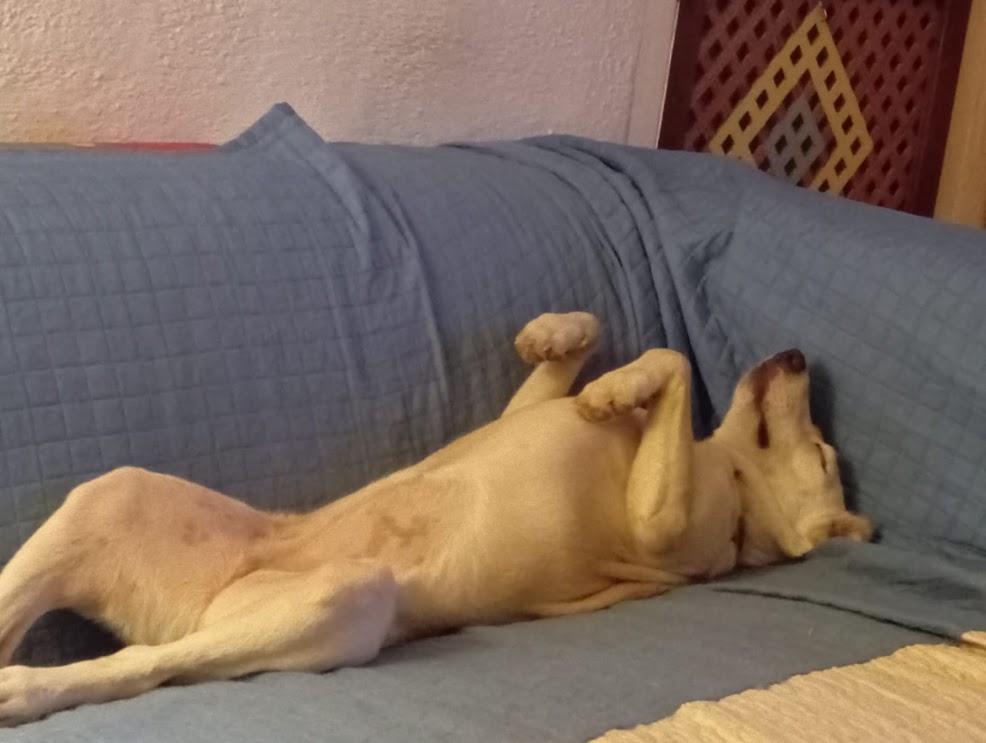
Leia at ease in her new home – when she first arrived here, she was afraid to come indoors.
So the summer, the worst of the heat, is now over and my fostering diary continues after all . . . Kim the Breton is still here and will be for the foreseeable future. His progress is slow but steady and he is now positively joyful in the mornings, delighted greetings when I wake up, capering around as we prep for going out. The wheels then do fall off a bit, he tends to pee triumphantly (reclaiming the immediate surroundings) then dash back home, and if there’s anyone in the street (it is a street, after all) there’s a bit of a meltdown and he’s bolting back all a-quiver. Still, he now ambles about the house shyly and spends more time in the study than brooding in the laundry or bedroom. He spent weeks lurking in the laundry trying to be invisible, great credit goes to the cheerful confident Dobby who is a true success story. He spent nine months growing up in a pound, went into foster, was adopted almost immediately by his foster mum because he is an absolute darling, then stayed here for a month while she recovered from an (unrelated!) broken shoulder.
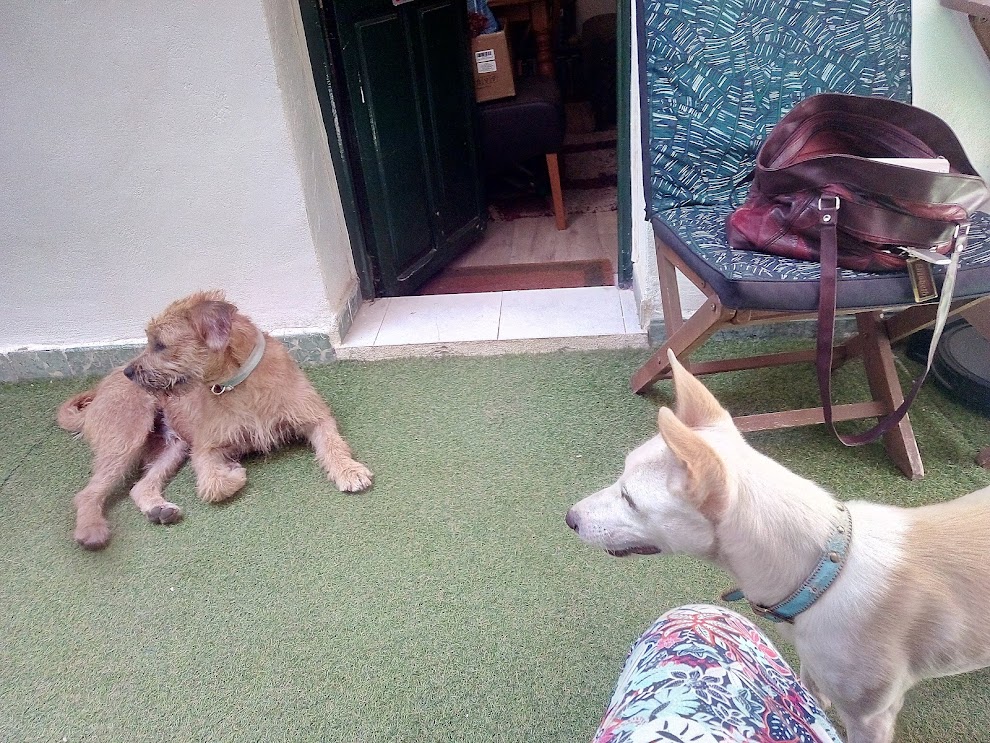
Dobby being eyed
cautiously by Leia
Dobby did wonders for Leia, who had never learned to play or really even socialise before he breezed in, and she blossomed almost immediately. She left for her forever home (where she is settling very happily, after her horrific start in life) two weeks after his arrival and he turned his attention full-time to Kim. They’d both done porridge at the same pound, overlapping by a few months, and although Kim simply wouldn’t play he did slowly pick up some of Dobby’s enthusiasm for life. He coped well when Dobby left, no regression, but no more progress, so Bonnie moved in a week ago.
She’s the real-deal Breton, longer ears, no tail, noticeably smaller than he is, very similar colouring, and he adores her. She is believed to around seven and was handed into the pound by her hunter owner with another Breton girl who is now also in foster care. She is unused to town life, or living indoors, but has embraced it all with aplomb and enthusiasm. She’s finding it difficult to adjust to walks on a lead, eyes pigeons with mild interest (although Bretons are used in Spain for songbirds, pigeons are the only birds she sees here) and keeps expecting me to put her to work – she hasn’t entirely grasped that her job is now to teach Kim to be happy and confident. Within two days he was so keen to show off to her he was finally out the front door, eleven weeks after his arrival, and he follows her around as much as she will permit. As she follows me around a lot of the time, we move about the house in procession. Taking photos is difficult because she likes to be close . . .

I post a lot on Facebook about the dogs so this blog is more talking generally about the fostering experience, changing a dog’s life as it did with Leia and is slowly doing with Kim. Bonnie, having retired from hunting, is learning to be a house dog in a small town. Dobby was an exuberant treat to have around. For anyone who lost a much-loved dog, as I did, fostering is an interim measure which heals the bruised hearts of both parties.
To those who say they couldn’t face caring for a dog they’d have to give up, yes. I did cry when Leia went, but I knew she was going on to a happy caring home and I’d played a real role in her ability to be adopted. Yes, I cried when Dobby had to go back! But you know what, nothing like the wrenching tears of grief. Fostering made a difference in all our lives, and that seemed to be worth blogging about.
So I did.


 Quite Contrary