Fostering dogs diary – 2

Still fostering … the turnover is going well, the fourth dog arrived a week ago, and now I know why people do it again and again, how the satisfaction and accomplishment makes up for the series of goodbyes.

Patience and kindness and routine and time – some need more time than others. In my case I had planned to do it for the sizzling hot Spanish summer, when so many of the expats in our social circle would be away, the house was closed to guests, and it would be lonely as hell with only Purdey’s fading memory for company. I offered to take dogs in urgent, temporary, need from both GADAH and Valle Verde. Selfish, oh yes, but in mitigation, benefit for the dogs – win win.  There are so MANY dogs needing temporary refuge in a home environment that one can choose where to help. Owners die unexpectedly, and the bereaved dog spirals into depression in a pound while a new home is sought.  Dogs are found injured, are patched up, and then need convalescence time outside the bustle and chaos of shelters. Working dogs which can no longer work and need to learn a whole new way of life. Dogs dumped because the owners want to go away for the summer, which have to accept their lives have changed, their families gone forever. Young dogs growing inconveniently bigger than expected, adored as puppies, suddenly unwanted, and needing confidence restored. Not every home suits every foster need, that would be impossible. You choose the ones where you can help.  Some rescue dogs have been badly bruised by life, they need time to adjust, and don’t always bond immediately, so they are not heartbroken by another goodbye, instead readied to make their next home the one that counts. Having said that, my most recent is bonding like glue! It usually, rule of thumb, takes 3 days for a dog to settle, 3 weeks to adjust to the new way of life, 3 months to bond completely. Short fosters don’t usually affect a dog’s heart, but reshape its attitude to life. 

As for fostering vs adopting – many of those wanting to adopt want a pet which will fit into their lives smoothly and easily, at the very least want to know what issues they will be resolving. Adopting a dog, THEN learning it is tricky with cats, or tries to bolt on walks, or hides under the bed, or is aggressive through fear – those are the failure stories which make people anxious about taking an unknown rescue dog straight from a shelter. Fostering can change that completely. One learns the animal’s fears, then gives them the breathing space to adjust, and when they do go to forever homes the adopting family knows exactly what to expect and what is needed to turn their anxious new companion into a loving confident friend . . . there is no dog more appreciative than one which has lost everything, and gets a second chance. Rescue pets are the most loving of all, once they dare to trust again, and fostering plays an important role in restoring trust in the human race.   
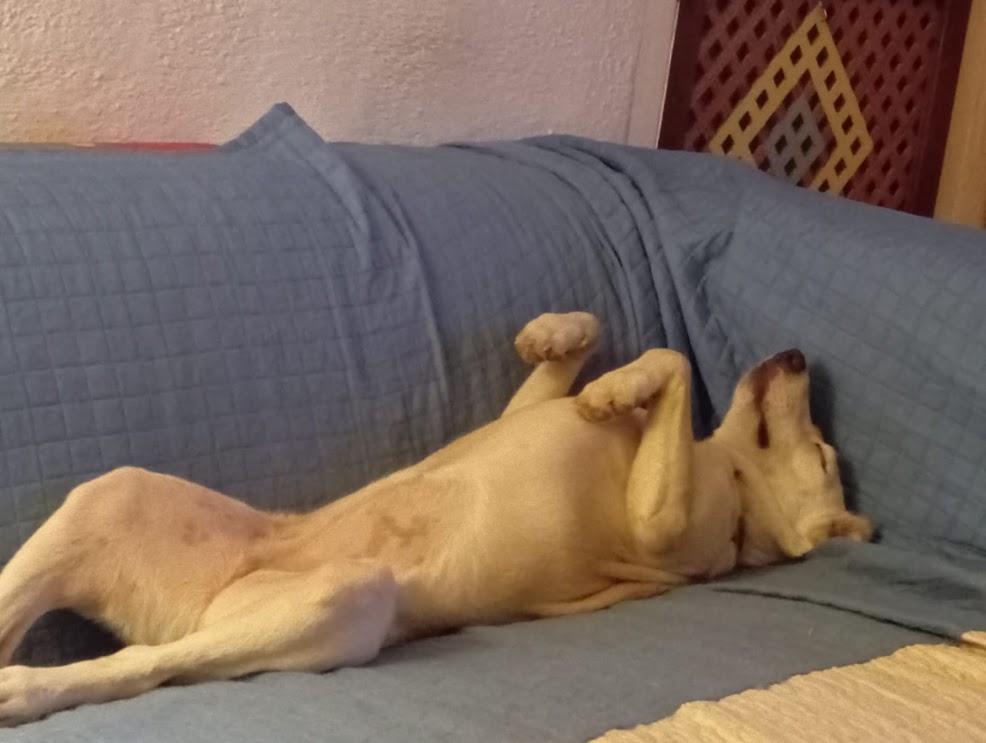
Leia at ease in her new home – when she first arrived here, she was afraid to come indoors.

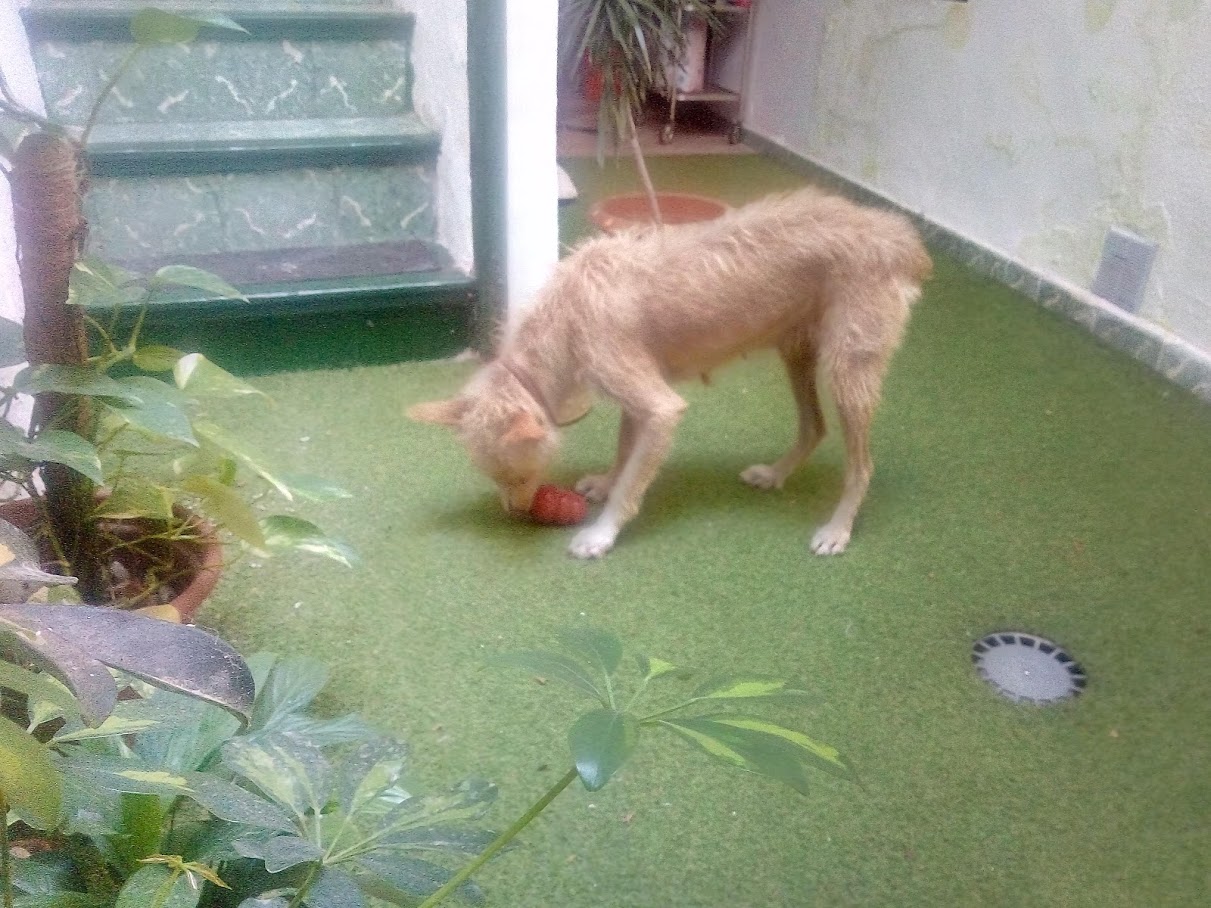
So the summer, the worst of the heat, is now over and my fostering diary continues after all  . . . Kim the Breton is still here and will be for the foreseeable future. His progress is slow but steady and he is now positively joyful in the mornings, delighted greetings when I wake up, capering around as we prep for going out. The wheels then do fall off a bit, he tends to pee triumphantly (reclaiming the immediate surroundings) then dash back home, and if there’s anyone in the street (it is a street, after all) there’s a bit of a meltdown and he’s bolting back all a-quiver. Still, he now ambles about the house shyly and spends more time in the study than brooding in the laundry or bedroom.  He spent weeks lurking in the laundry trying to be invisible, great credit goes to the cheerful confident Dobby who is a true success story. He spent nine months growing up in a pound, went into foster, was adopted almost immediately by his foster mum because he is an absolute darling, then stayed here for a month while she recovered from an (unrelated!) broken shoulder.
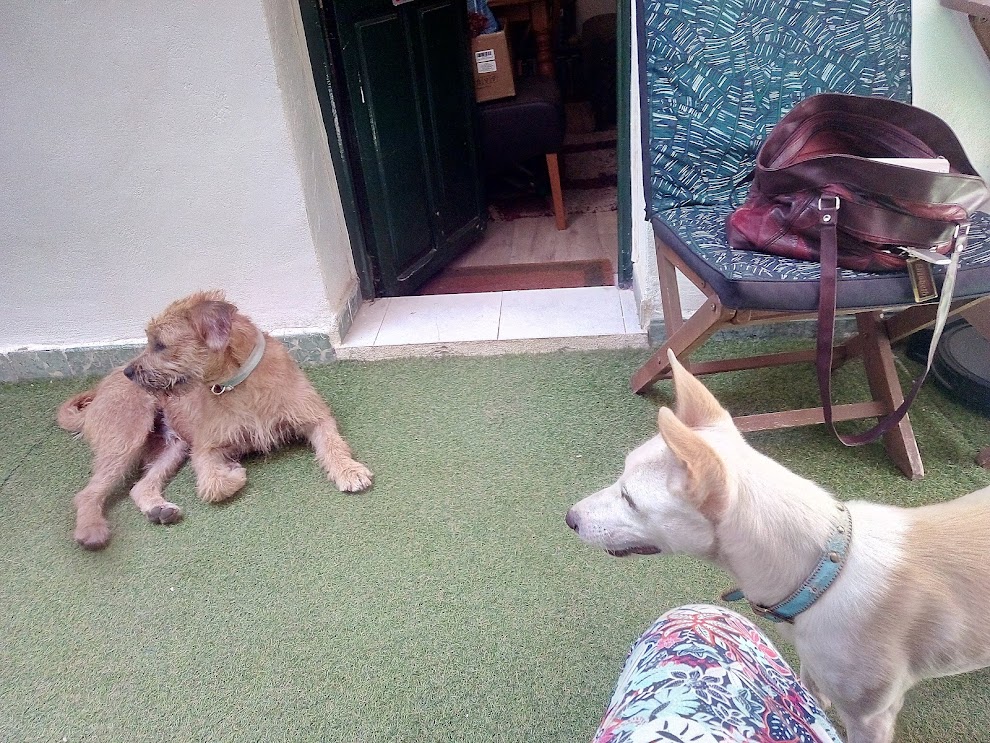
Dobby being eyed

cautiously by Leia

 Dobby did wonders for Leia, who had never learned to play or really even socialise before he breezed in, and she blossomed almost immediately. She left for her forever home (where she is settling very happily, after her horrific start in life) two weeks after his arrival and he turned his attention full-time to Kim. They’d both done porridge at the same pound, overlapping by a few months, and although Kim simply wouldn’t play he did slowly pick up some of Dobby’s enthusiasm for life.  He coped well when Dobby left, no regression, but no more progress, so Bonnie moved in a week ago. 

She’s the real-deal Breton, longer ears, no tail, noticeably smaller than he is, very similar colouring, and he adores her. She is believed to around seven and was handed into the pound by her hunter owner with another Breton girl who is now also in foster care. She is unused to town life, or living indoors, but has embraced it all with aplomb and enthusiasm. She’s finding it difficult to adjust to walks on a lead, eyes pigeons with mild interest (although Bretons are used in Spain for songbirds, pigeons are the only birds she sees here) and keeps expecting me to put her to work – she hasn’t entirely grasped that her job is now to teach Kim to be happy and confident.  Within two days he was so keen to show off to her he was finally out the front door, eleven weeks after his arrival, and he follows her around as much as she will permit. As she follows me around a lot of the time, we move about the house in procession.  Taking photos is difficult because she likes to be close . . .

I post a lot on Facebook about the dogs so this blog is more talking generally about the fostering experience, changing a dog’s life as it did with Leia and is slowly doing with Kim. Bonnie, having retired from hunting, is learning to be a house dog in a small town. Dobby was an exuberant treat to have around.  For anyone who lost a much-loved dog, as I did, fostering is an interim measure which heals the bruised hearts of both parties. 

To those who say they couldn’t face caring for a dog they’d have to give up, yes. I did cry when Leia went, but I knew she was going on to a happy caring home and I’d played a real role in her ability to be adopted. Yes, I cried when Dobby had to go back! But you know what, nothing like the wrenching tears of grief. Fostering made a difference in all our lives, and that seemed to be worth blogging about.

So I did.

The learning curve of living with a #podenco – a truly Spanish dog

I’m no expert. Total newbie, in fact. There have been many dogs in my past and for a large chunk of that past they’ve been rescue dogs of the bullbreed type, mainly staffies. The last 8 years, for example, was spent with a bulldog / Frenchie cross with a will of iron who only went into rescue because her doting owners unexpectedly produced a baby and she refused pointblank to accept the interloper. To the end of her long life she wasn’t to be trusted near a crying baby. Difficult rescue dogs? Been there, done that. A podenco couldn’t be more different, and I hadn’t expected such a learning curve.  So here’s what I’ve learned so far: some of it I looked up, some of it was passed on from others, and most of it from Purdey.

The Spanish have a reputation for cruelty to animals – it must immediately be said I’ve had Spanish guests here at the Casa with their dogs and even, in two cases, their cats, and they were devoted to their pets and couldn’t bear to be separated from them. The town has a conventional complement of much-loved house pets, often met out on walks. Like many generalisations it is not true of the majority. But – podencos (it literally means hound), a group of Mediterranean hare-hunting sighthounds, differing slightly by region (eg Ibiza, Andalusia, Canary Islands, etc) aren’t often as lucky. They are quite literally considered tools.

A working pod will often be kept in a dark shed, and is generally half-starved during hunting season to make it keener for the hunt. When the season ends, many are turned out to fend for themselves, and the persistent are driven miles away to be dumped, or worse. Pods have been dealt a fairly crappy hand in life and many people, both in Spain and out, are stepping up to adopt rescued ones. They make marvellous pets but they are not like other dogs. They are not, by the way, a breed as such, more an unmistakable type, with enormous ears, jaunty tails, and strong wiry frames.  They come in three sizes, small, medium, and large, and can be rough or smooth coat.

Purdey is a almost classic Andalusian medium-sized rough coat pod but has no tail – I don’t know whether it was deliberately docked, amputated after a mishap, or is a birth abnormality. She is around 3 years old, was found living alone in a tumble-down house in the campo, and handed over to me a fortnight ago. She looks dainty and rangy by turns, is immensely strong for her size, and uses her wonderful ears like semaphore flags.

So far she has proved charming, gentle, and increasingly affectionate. I was concerned that I’d not be able to give her marathon walks and runs, and that the household, especially during this covid year, is excessively quiet – me and an elderly cat.  After all, research says that they like children, love a bustling household with a lot going on, and many have taken to agility training and enjoy it very much. Turns out, though, they don’t need to be galloped twice a day, or worn out before they can sleep, but they do need regular walking. Great for me – that’s why I wanted a dog.

Loving and affectionate, yes. Lapdogs, not so much. Purdey likes to be near me, or where she can see me, but far from having to be chased off the bed or sofa, she won’t even sleep on a thickly padded dog bed and prefers a knobbly old dog rug with no padding whatsoever. She’s used to alone-time and doesn’t nag for constant attention, although when I do reappear she is flatteringly delighted. She would probably stand rockstill to the end of time if I would just keep brushing her – it is one of her passions in life. When it stops she sighs, does a nose-poke thank you, and heads to the knobbly old rug. Great for me – I don’t like dogs that demand constant entertainment and playing. She has no concept of play at all, and looks oddly at me when I bounce a ball, or squeak a toy. The one exception is the kong, which she considers an admirable way of serving dog pâté. We’re working on play.

As dogs they are hardy, robust, and fend remarkably well for themselves when turned out, as so many are, after hunting season. The downside is that they are skilled scavengers, and she ransacked the rubbish bin the first time I left her alone. She’ll also pinch the cat’s food and anything left out, even when she’s just had a meal, and gives me a guilty grin when I scold. That’s improving already, with regular food, but I don’t think she’ll ever completely lose the habit.

I’m warned I may never be able to let her off the lead on a walk because however devoted they are to owners, they are insatiably curious explorers.  Be aware, also, that a podenco puts Houdini to shame when it comes to wriggling out of collars and harnesses. A collar will likely not be enough and a harness must be fitted snugly. Purdey’s was adjusted by another half inch on each side after she showed me just how good she is. That was an exciting half hour through the streets of Velez, with her trotting anywhere between ten to fifty yards ahead, sublimely unaware of my cold dread that she would pop out in front of a car as I panted in pursuit.

They are gently stubborn – once they have decided a course of action, it is hard to convince them otherwise.  Purdey learned instantly, when I squawked, that peeing in the middle of the atrium was not going to be popular.  Her home loo became the terrace, which is near the hosepipe and easily washed down. It has also become her only loo. She loves walks, she is fascinated by what other dogs have left on the street and in the rough grass, but no matter how long we stay out, she pops up to the terrace with a sigh of relief when we get back. After the first week with me she did start peeing occasionally when out, and seemed embarrassed by my lavish praise. I’d welcome any advice on getting her preferring outdoors to indoors.

They are sighthounds, those huge ears are like radar antenna, and they have hunter reflexes. Introductions to cats must be handled carefully. There was no problem introducing them, but my cat is furtive around dogs, and likes to make quick dashes from hiding, especially outside at night. With a bulldog, no problem, he was out of range before she had her legs sorted out. With a sighthound, a couple of heart-stopping dashes until Purdey finally accepted his resemblance to a rabbit was purely coincidental. Me shouting NO devastated her: telling her she was a Bad Dog, the second time, reduced her to quivering jelly. Sprinting after small animals is what she was bred to do. In this pic (I’m a rubbish photographer) the cat looks nearly her size but is merely nearer the camera. They’re not friends, not yet, but settling down together.

Pods may be hunters, but they are unexpectedly timid. I’m used to imposing my will on difficult stubborn dogs – hence the shout NO. Purdey is highly intelligent and desperate to please, and that’s characteristic of the type too. If danger beckons they will remove themselves and expect you to have the sense to do the same. Your pod will not be challenging visitors, or bringing up the rear barking defiantly while you get to safety. On the bright side, they won’t pick fights with other dogs, and will go out of their way to avoid confrontation. This is proving immensely restful after all those years of bull breeds.

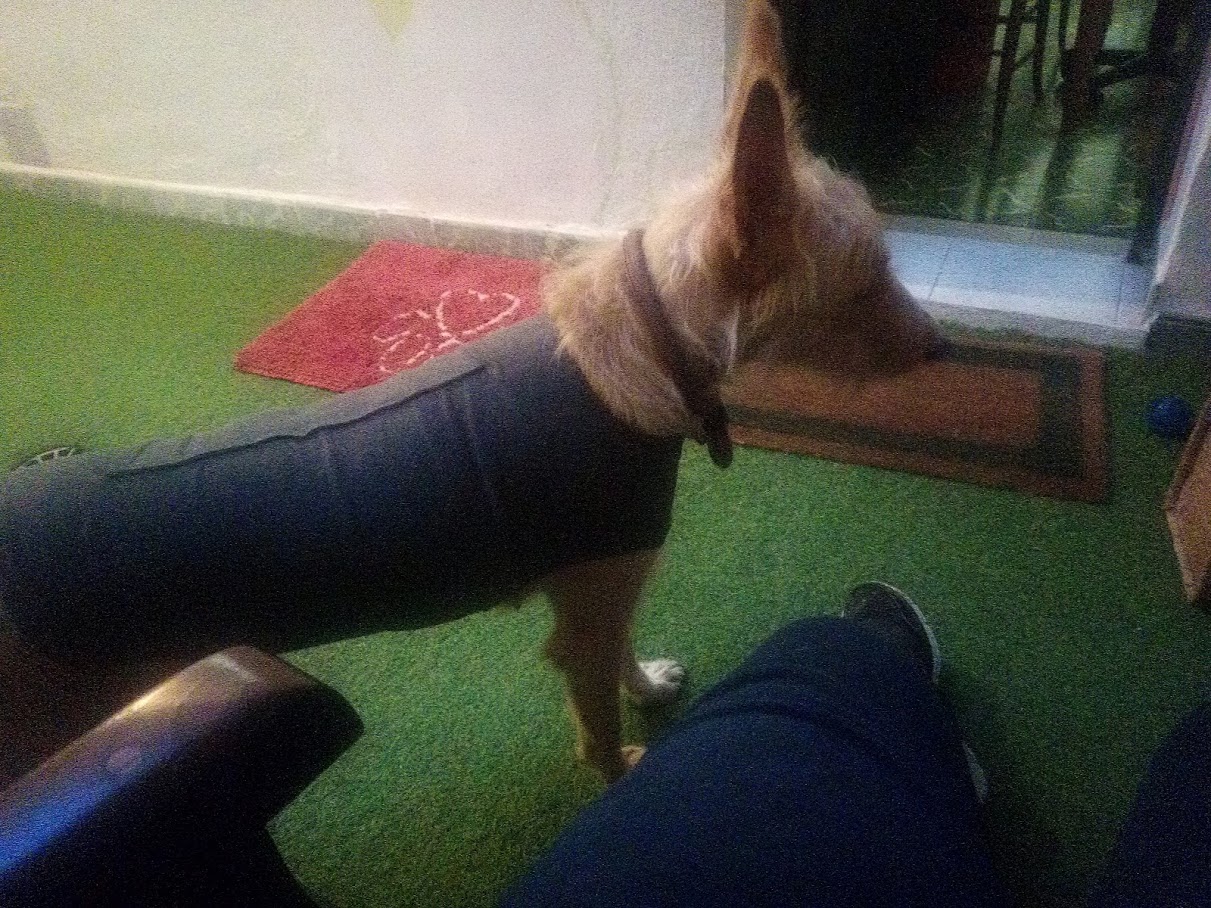
She was so timid at first that I tried her in a thunderjacket – she didn’t object, but then she never does. It could help for high-stress outings like vet visits. I might need to change to a female vet as she is definitely afraid of men.

If you want a roly-poly bundle of lively fun which will chase after balls and bring them back, be delighted by toys, and protect you to its dying breath, a pod won’t suit. My friend has had his eight years and Purdey is newly moved in, but in these things they are the same – very traditional dogs, bred to work for their keep, self-effacing, independent, needing only food and exercise, gratefully returning kindness and a place in your home with affection and the desire to fit in. His dog barks at the approach of cars (but then that’s out in the campo, so it usually means a visitor) and both dogs literally dance with delight at moments of high excitement.   

My phone takes awful photos which don’t do her justice. She’s utterly lovely.