Fostering rescued dogs, especially ones with special needs – yes / no? #OneYearOn #Spain

I was actually a bit shocked when I posted on Facebook about my two new fosters in June 2024 and a friend praised them and said she followed a group for failed fosters. What? Letting the dogs down? And of course as everyone but me knew, failure is being unable to give them up and keeping them and is a Good Thing.

I’d lost a dog I loved very much before she’d even had the chance to slow down and grow old and prepare me for her going, when  I’d always thought she’d be my last dog.  I was even casting around for ways of securing her future if I pre-deceased her.  This rambling eccentric old house was suddenly echoingly empty and it was unbearable. I decided that long-term I’d adopt an older dog but for the interim I would do emergency short-term fosters, a kind of payback for the years of love and company from the three rescue dogs I’d serially owned.  For a couple of months, I said.

In the last year there have been six, two still with me. This blog is really for anyone thinking along the same lines, perhaps for similar reasons. Would I do it again? Should you do it? Aren’t rescue dogs from traumatic backgrounds half-crazed with fear and distrust? Don’t foster dogs get too attached (and you to them) to ever be given up? Isn’t it heart-breaking to hand over a dog that’s lived with you for months?

For starters, the choice is very nearly endless, especially in Spain where unwanted dogs in good health can by law no longer be put to sleep. Municipal pounds are crammed, rescue shelters are at capacity, charities at full stretch financially, and anyone prepared to help a dog through the transition from trauma to normality, ready for homing, can refuse dogs they think too big, too small, too wild, too damaged, too much, and still there are dozens, hundreds, to choose from. The safest are often older and have been abruptly orphaned , plunged into crowded cages and runs after a lifetime of privileged home life, until a new permanent home can be found, and you are offering only shelter and peace. You can leave the really challenging ones for experts and still change a dog’s life from despair to relief.  Emotionally – it’s not unlike having visitors. You know they aren’t there forever, so you enjoy the time together very much and yes, miss the company when they go to a permanent place, but it isn’t devastating. There are tears, or there were for me, but not heartbreak.  The ones with special needs – it is indescribable how it feels to help a dog through despair to trusting human beings again, ready to join a family of its very own.

Fostered dogs are owned by the charity that rescued them and the usual arrangement is that the charity covers vet bills and unexpected expenses, has absolute final say on any adoption arrangements, and will instantly take the dog back at any point if your circumstances change. If special diet or training is required, some charities offer more support. “Residencies” charge a monthly rate for keeping dogs in semi-confined conditions, giving them any medication necessary, and letting them slowly acclimatise.

I’ve had dogs from, or via, Valle Verde and Give A Dog A Home (GADAH) Malaga, and two from a charity which had to close (due to lack of funds rather than love of dogs and passion for their well-being). That’s an ongoing problem – so very many dogs (and cats) and so little money, so few homes.   

I’ve said never again twice, (because of the tears, not because of bad experiences) then done it again, twice. I do think both my current ones are failed fosters, though. They are part of the fabric of my life now.  Agoraphobic Kim – well, look at him now. He will probably always be shy.

Did that answer your questions?  The rest is a self-indulgent memory-fest for the six fosters who have shared my life in the last year. All have had unique stories, not all traumatic.

Kim’s been around a year and celebrated his anniversary with a mini hike in the morning with his current foster sister AND  a former foster sister, now adopted locally and extremely happy. We went out socially in the afternoon to a café to catch up with friends, and his anniversary supper included roast pork, something to which he is very partial. Not bad for a dog who took weeks to be coaxed out of determined self-imposed exile in the laundry, months to go out the front door on his first walk, who fled in terror when anyone entered the house,  and literally crapped himself if they followed him to his bed. Progress has been slow but steady. Last weekend  he and Carina came away on holiday with me to escape the local fiesta, which is heavy on fireworks and recreation of historic medieval warfare (moros y cristianos, muskets and swords and marching bands, huge fun unless you’re a nervous dog) and there were all sorts of challenges to face. Entering a strange house – charging about  off-lead in a totally strange place in the middle of nowhere (no fences, just miles and miles of rural Spain) – new routines. He loved it. By the second day he was going into the house under his own steam (ok, diving straight under the table and staying there, he’s still Kim), by the third, he was doing his own very special dance of welcome when our host emerged outside with cups of coffee. Neither dog went far without me but both begged for constant walks when we went outside. He’d vanish into the distance, appearing in under a minute when I turned back. He’s still to bark at home when the doorbell rings (at least he no longer disappears at speed into the safety of the bedroom) but on holiday he growled and barked at a distant dog which decided not to investigate after all.
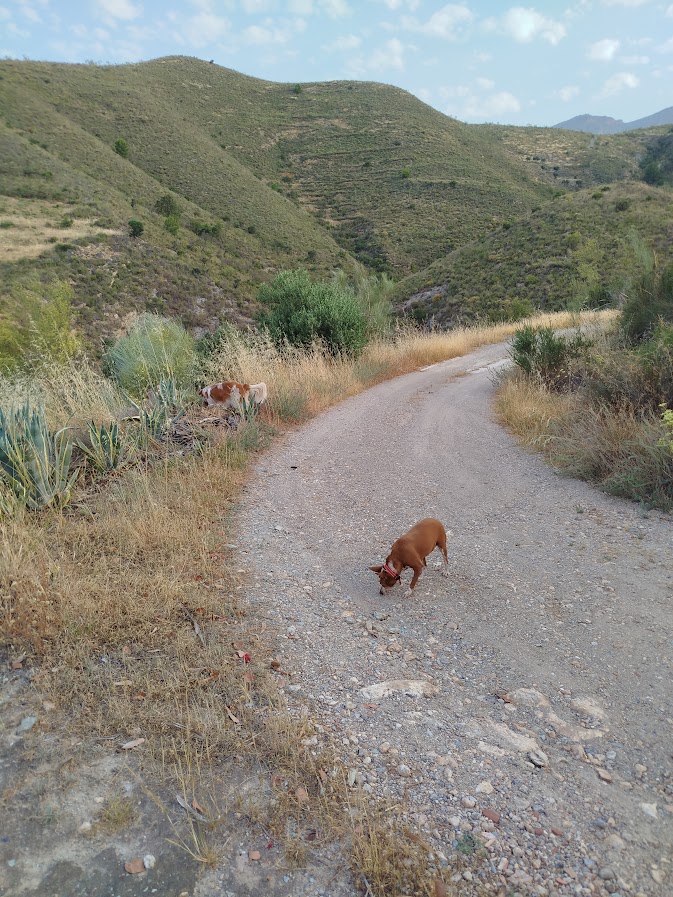
Kim and Carina exploring in the campo

Carina

Carina is the sixth foster, a very dainty older podencohuahua (there’s a big dollop of Chihuahua in there) who has been  here a couple of months and is permanently joyful, putting aside her fairly horrible past and focusing only on the here-and-now, always up for the adventures of the day. Even when they are as mundane as housework or taking rubbish to the big street bins, she’s in.  Her huge maimed ears are up at the faintest sound, her tail permanently ready to wag, and she adored, and was adored by, my visiting toddler granddaughter.
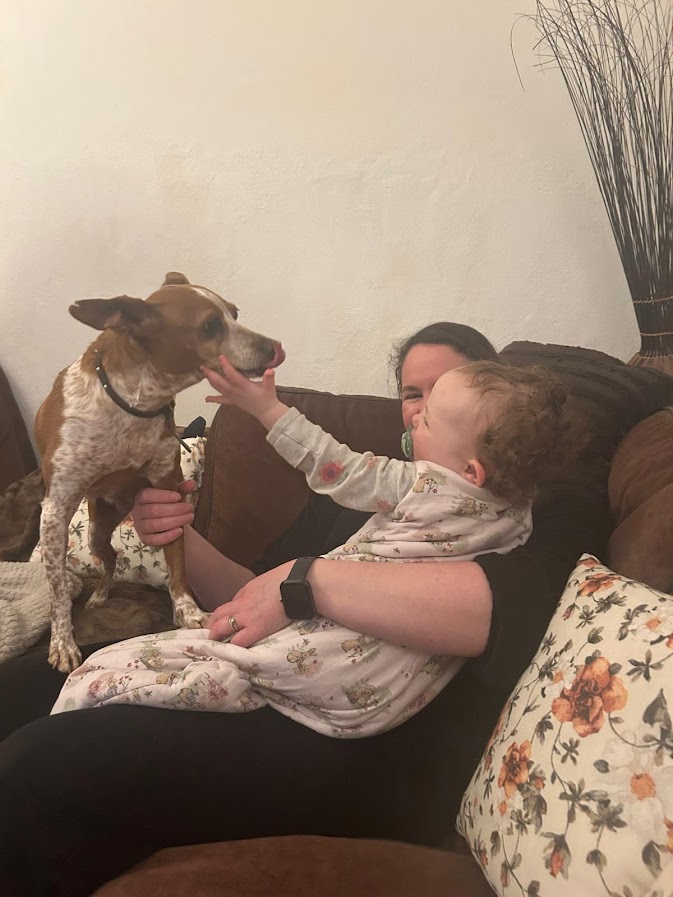
Carina meets a human her very own size

She enjoys company generally but a human her own size delighted her. She’s very special, very ready to go to a forever home, and yet the thought of her going . . . well, there are tears every time one goes to their own forever home, but Carina and Kim between them have become perfect companions. We’re all reddish and freckled, all three tolerant of our very separate ways, all rubbing along together. I’ve been spoiled by Blanquita (now Chica) finding her happy home just around the corner and meeting her often, so a perfect home for Carina would have to be local, and loving, and special.
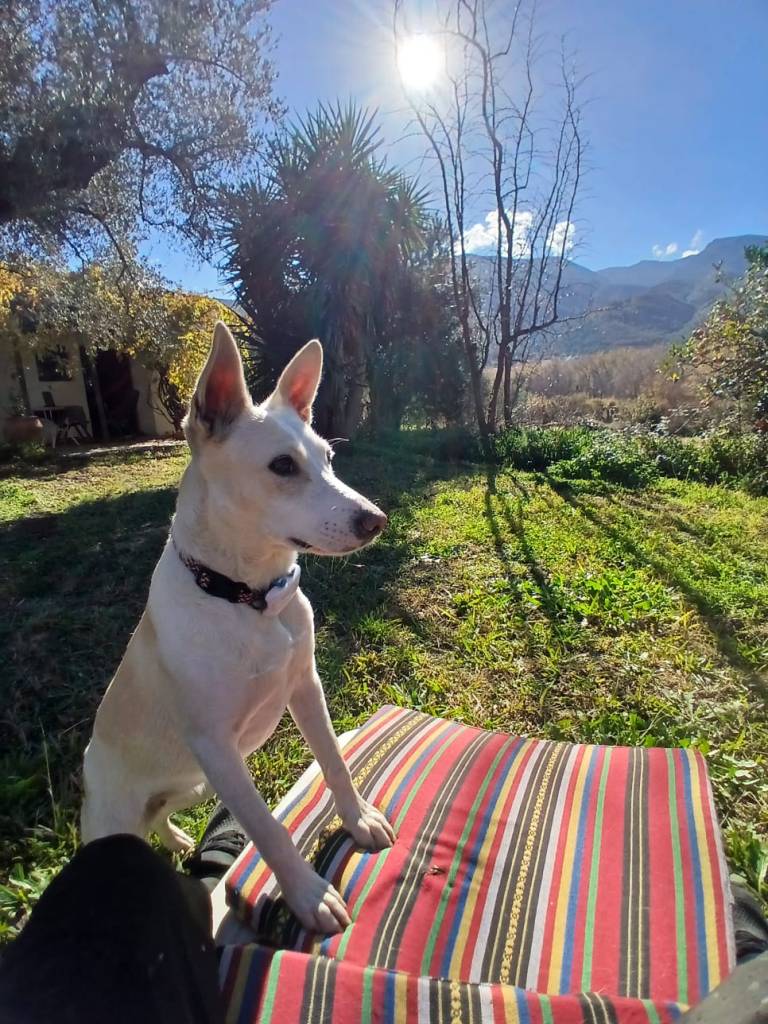
Leia – the first foster

Leia, the very first foster (by 2 days) of them all, rescued from a horrible existence in a cage with rare visits from an indifferent owner (who should be stuck in a cage for a year too, fed twice a week, but hey, just my opinion) went to the wrong owner first and that was devastating, but then found the place perfect for her and is utterly happy now, living her best life.
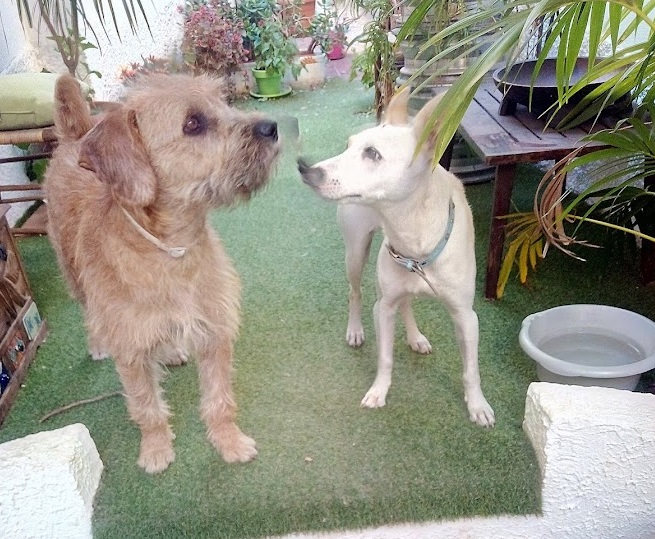
Dobby and Leia

Dobby, adopted from a pound, was only ever on loan while his owner was recovering from some bad luck, and I follow his adventures on Facebook, and he’s grand, hiking socially several times a week for amazing distances, and loving his life. A super dog who took both Leia and Kim in hand and coached them in being dogs.
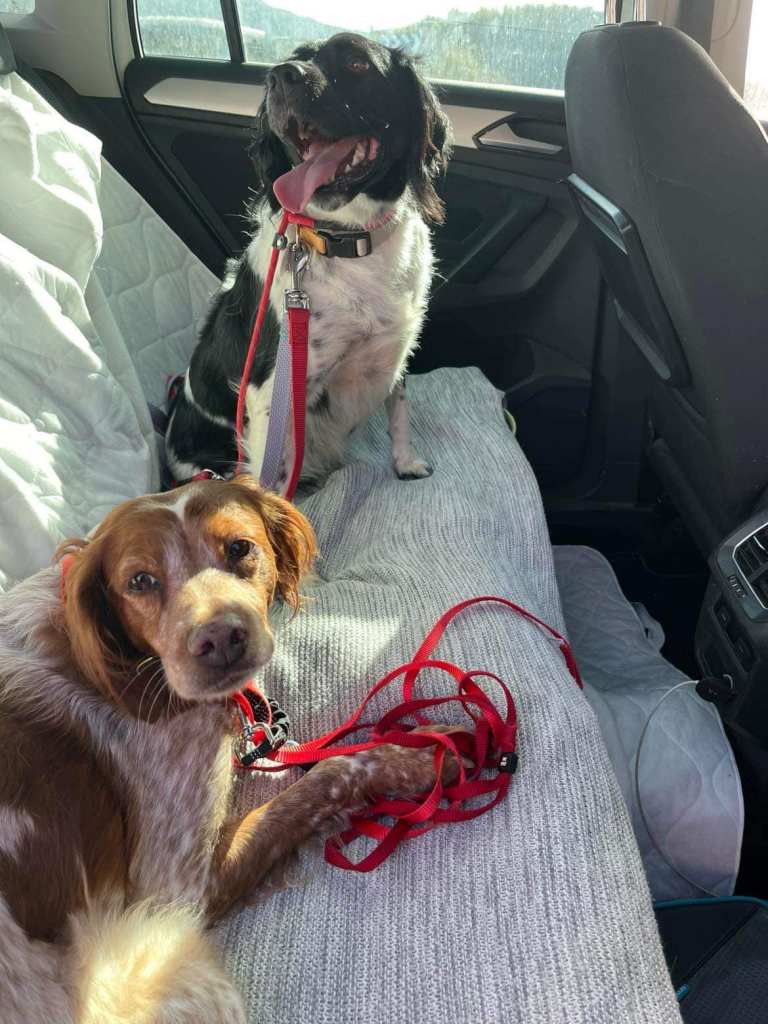
Bonnie on the day she left and became Mia

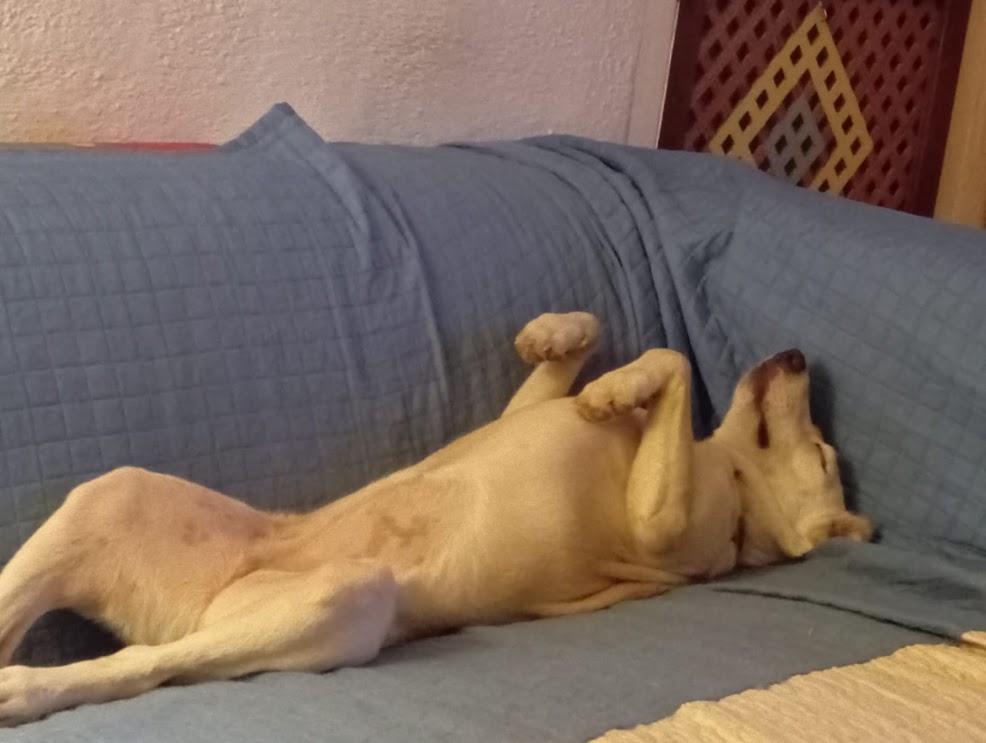
Bonnie, a Breton spaniel who was formerly briefly Prima and is now Mia, was Kim’s favourite – he’s half Breton spaniel (a Breton Collie, we call him) and worshipped her from day one, following her about like a puppy (he and Carina get on, but are not inseparable).  She wasn’t a horror story – handed in by her hunter owner when she slowed down, just needing to adapt to living in a home, which she did effortlessly. We get occasional updates via WhatsApp about Mia  – she’s I think the oldest of the lot but enjoys a happy active life living a few hours away with another rescued Breton spaniel and photos are usually of her looking smug on the sofa.  I deliberately chose this one of her leaving for her new life – there was no distress.
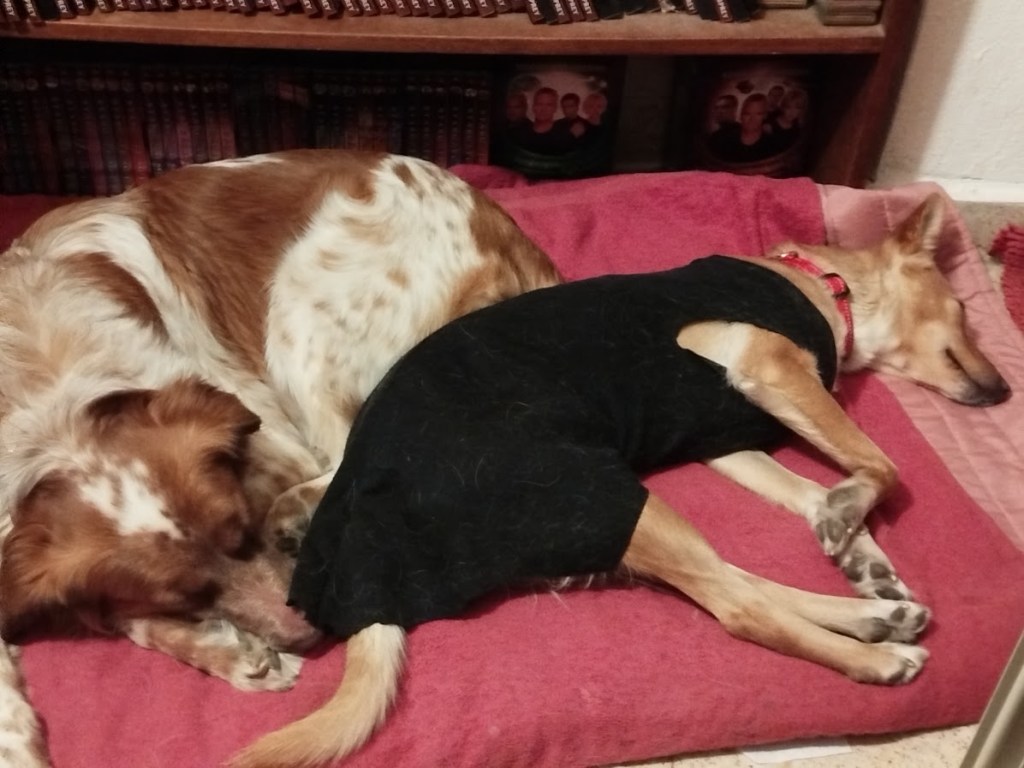
Blanquita and Kim preferred to share in cold weather

I said at that point no more fosters, too many tears when they left, but Blanquita, a podenco maneto dumped at a petrol station, living wild for a year while she waited for her faithless owners to return, fed by the kind staff at the petrol station shop but refusing to be caught, was an emergency after she was attacked by a pack of hunting dogs and badly injured. Kim took an active part in her recuperation and reintroduction to normality, even gulping down his fear to go on walks to encourage her, gentle and protective. She became Chica and they are always delighted to see each other – she visits if her owners have to leave her alone for longer periods, and she and Carina play while Kim watches benignly.  
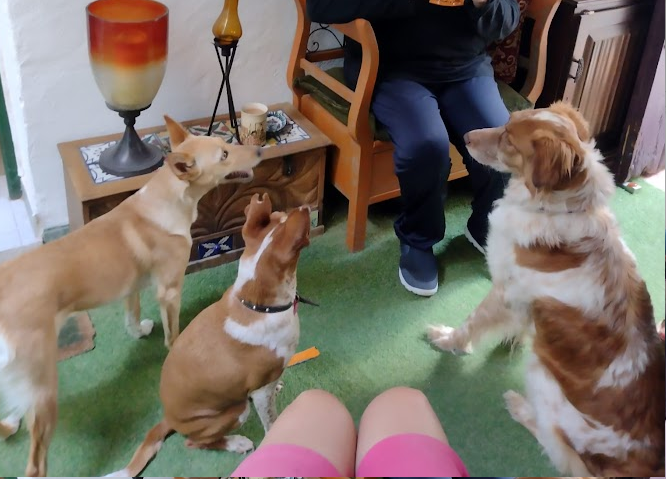
Chica visiting Carina and Kim – treats? Really? Ooh

Six special dogs. No regrets.

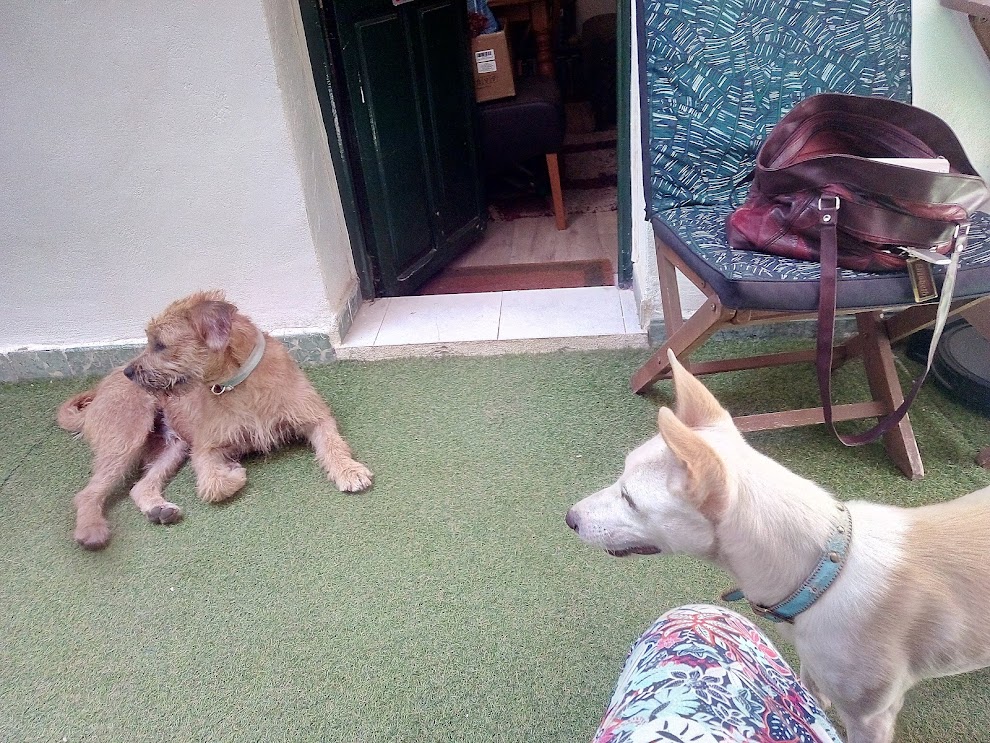
Carina, Bonnie and Kim, Dobby, oops (Dobby teaching Leia to play), Kim, Blanquita, Leia

Fostering dogs diary – 2

Still fostering … the turnover is going well, the fourth dog arrived a week ago, and now I know why people do it again and again, how the satisfaction and accomplishment makes up for the series of goodbyes.

Patience and kindness and routine and time – some need more time than others. In my case I had planned to do it for the sizzling hot Spanish summer, when so many of the expats in our social circle would be away, the house was closed to guests, and it would be lonely as hell with only Purdey’s fading memory for company. I offered to take dogs in urgent, temporary, need from both GADAH and Valle Verde. Selfish, oh yes, but in mitigation, benefit for the dogs – win win.  There are so MANY dogs needing temporary refuge in a home environment that one can choose where to help. Owners die unexpectedly, and the bereaved dog spirals into depression in a pound while a new home is sought.  Dogs are found injured, are patched up, and then need convalescence time outside the bustle and chaos of shelters. Working dogs which can no longer work and need to learn a whole new way of life. Dogs dumped because the owners want to go away for the summer, which have to accept their lives have changed, their families gone forever. Young dogs growing inconveniently bigger than expected, adored as puppies, suddenly unwanted, and needing confidence restored. Not every home suits every foster need, that would be impossible. You choose the ones where you can help.  Some rescue dogs have been badly bruised by life, they need time to adjust, and don’t always bond immediately, so they are not heartbroken by another goodbye, instead readied to make their next home the one that counts. Having said that, my most recent is bonding like glue! It usually, rule of thumb, takes 3 days for a dog to settle, 3 weeks to adjust to the new way of life, 3 months to bond completely. Short fosters don’t usually affect a dog’s heart, but reshape its attitude to life. 

As for fostering vs adopting – many of those wanting to adopt want a pet which will fit into their lives smoothly and easily, at the very least want to know what issues they will be resolving. Adopting a dog, THEN learning it is tricky with cats, or tries to bolt on walks, or hides under the bed, or is aggressive through fear – those are the failure stories which make people anxious about taking an unknown rescue dog straight from a shelter. Fostering can change that completely. One learns the animal’s fears, then gives them the breathing space to adjust, and when they do go to forever homes the adopting family knows exactly what to expect and what is needed to turn their anxious new companion into a loving confident friend . . . there is no dog more appreciative than one which has lost everything, and gets a second chance. Rescue pets are the most loving of all, once they dare to trust again, and fostering plays an important role in restoring trust in the human race.   

Leia at ease in her new home – when she first arrived here, she was afraid to come indoors.

So the summer, the worst of the heat, is now over and my fostering diary continues after all  . . . Kim the Breton is still here and will be for the foreseeable future. His progress is slow but steady and he is now positively joyful in the mornings, delighted greetings when I wake up, capering around as we prep for going out. The wheels then do fall off a bit, he tends to pee triumphantly (reclaiming the immediate surroundings) then dash back home, and if there’s anyone in the street (it is a street, after all) there’s a bit of a meltdown and he’s bolting back all a-quiver. Still, he now ambles about the house shyly and spends more time in the study than brooding in the laundry or bedroom.  He spent weeks lurking in the laundry trying to be invisible, great credit goes to the cheerful confident Dobby who is a true success story. He spent nine months growing up in a pound, went into foster, was adopted almost immediately by his foster mum because he is an absolute darling, then stayed here for a month while she recovered from an (unrelated!) broken shoulder.

Dobby being eyed

cautiously by Leia

 Dobby did wonders for Leia, who had never learned to play or really even socialise before he breezed in, and she blossomed almost immediately. She left for her forever home (where she is settling very happily, after her horrific start in life) two weeks after his arrival and he turned his attention full-time to Kim. They’d both done porridge at the same pound, overlapping by a few months, and although Kim simply wouldn’t play he did slowly pick up some of Dobby’s enthusiasm for life.  He coped well when Dobby left, no regression, but no more progress, so Bonnie moved in a week ago. 

She’s the real-deal Breton, longer ears, no tail, noticeably smaller than he is, very similar colouring, and he adores her. She is believed to around seven and was handed into the pound by her hunter owner with another Breton girl who is now also in foster care. She is unused to town life, or living indoors, but has embraced it all with aplomb and enthusiasm. She’s finding it difficult to adjust to walks on a lead, eyes pigeons with mild interest (although Bretons are used in Spain for songbirds, pigeons are the only birds she sees here) and keeps expecting me to put her to work – she hasn’t entirely grasped that her job is now to teach Kim to be happy and confident.  Within two days he was so keen to show off to her he was finally out the front door, eleven weeks after his arrival, and he follows her around as much as she will permit. As she follows me around a lot of the time, we move about the house in procession.  Taking photos is difficult because she likes to be close . . .

I post a lot on Facebook about the dogs so this blog is more talking generally about the fostering experience, changing a dog’s life as it did with Leia and is slowly doing with Kim. Bonnie, having retired from hunting, is learning to be a house dog in a small town. Dobby was an exuberant treat to have around.  For anyone who lost a much-loved dog, as I did, fostering is an interim measure which heals the bruised hearts of both parties. 

To those who say they couldn’t face caring for a dog they’d have to give up, yes. I did cry when Leia went, but I knew she was going on to a happy caring home and I’d played a real role in her ability to be adopted. Yes, I cried when Dobby had to go back! But you know what, nothing like the wrenching tears of grief. Fostering made a difference in all our lives, and that seemed to be worth blogging about.

So I did.

A sad farewell – and hello hello

At the end of May, my podenco Purdey died unexpectedly – I took her to the vet looking for a tonic and instead had to say goodbye. They’re a hardy robust breed and by the time she started drooping the cancer in her liver and spleen was too advanced for any treatment to be possible.  This was always my favourite photo of her, looking dainty and pretty rather than her usual slightly-scruffy and rangy. RIP Purdey. You were a fantastic companion and it is so hard to talk about you x

She’d been found living in a ruin in the campo and I’d taken her in during a Covid lockdown because I was, at the time, the only person who could. I had been more than a bit dubious about it, knowing nothing about podencos except that I didn’t think I could give a dog bred to hunt and run enough exercise. Turned out street walks were fine, with occasional runs in the veld campo, and the bonus of her being invited along by friends on hikes. Temporary slipped unnoticed into permanent, she was a fabulous lovely dog and in her 3 years with me she had made friends all over the village. For that matter, because I have a guesthouse, she had friends all over Europe and I’m still getting whatsapps and mails signed off ‘lots of love to Purdey’. She’d become an absolute asset, not instantly friendly but steadfast in friendships made and greeting repeat guests with delighted recognition, especially those who borrowed her for walks. Adopt a podenco? Absolutely. Fab dogs, self-willed but so loving, so ready for any adventure that presents itself, so worth it.  

Unthinkable to replace her promptly – apart from anything else, my dogs tend to find me, not the other way round – and yet unbearable to live without even a cat. Toks the cat had lived 20 years, overseeing Leela’s seven years in the family, and overlapping with Purdey, and now this big house had no welcome when I got home, no interested face suddenly appearing when the fridge door opened. Even going to the loo unescorted wasn’t the privacy treat it should have been.

I asked a couple of rescue centres if they had any dogs needed urgent temporary respite, and they did. In time I will likely take an older orphaned dog and we can potter gently together into old age but for now a fairly quick turnaround seemed best, young dogs screwed over by life but still with a good chance of starting over and finding forever homes after an intervention to reset.  

Kim, a part Breton with a strong look of the breed, (bird dogs, also known as Brittany spaniels) is beautiful, and gentle, but virtually paralysed by shyness. He was unchipped and his history is unknown – he came onto the rescue radar in February in a city pound, and hid in the back of his run, then was taken by GADAH into a pack of Bretons at a residency where he did his best to efface himself. He’s estimated to be around three years old. The fostering goal is to finish the course of pills he’s on until he’s cured of the two Mediterranean diseases he’s picked up – a matter of weeks to go – but also to rebuild his confidence and get him to interact with people. From the second day there was a tail thump in greeting, now, a week in, he’ll lean into a hug and shyly invite tummy rubs, but he still won’t move  if there’s any chance of being seen. I put food and water at the other end of the room and the bowls are emptied within seconds of me leaving, but if I stay, (and I have taken a book and stayed) he’ll go hungry rather than show he can move. He sneaks to the terrace to make his toilet when I am safely out. The ultimate goal is to get him going for walks on a lead and, a week in, it’s hard to tell whether that will be another week, a year, or never . . .

Leia – and I hadn’t intended to take two – is likely to be a much shorter stay. She was liberated from the cage where she’s spent the first neglected year of her life to have her mangled tail amputated. Valle Verde took up her story and called for an urgent foster home, and she was chipped and spayed and brought here not only to recuperate but to learn about the gigantic world outside the tiny confines of a cage. She’s a little white dog with a touch of podenco around the ears, a mix of total innocence, nerves and sheer pluck. She’s enjoying her three walks a day, toilet-trained herself almost immediately, is learning how to interact with dogs and cats met on the walks (she and Kim share space with civility rather than enthusiasm, although they huddled on the same dog bed during the fiesta fireworks) and slowly grasping that dogs met want to sniff under her missing tail, not attack the stump. She lived so much in solitude that she likes lots of alone time but she grasped the simple house routine almost immediately. While she barely lifts her head enquiringly when I visit at random intervals (she adopted the laundry, which is a separate room, as her favourite haven, or the upstairs patio  when the washing machine is being noisy) she is up and eagerly waiting at playtime in the late afternoon, and for the walks at 9 am, 3 pm, and 9 pm. She’s recovered from both surgeries and finished her meds and the only remaining goal on her checklist is to get her a bit more confident about exploring, especially when she is invited into ‘strange’ places – like my part of the house! She panics and flees for the terrace and her laundry. She still doesn’t seek stroking, was stiff and awkward at first with cuddles, now enjoys them very much and is a bright, lively, pretty little dog, so very ready to give and receive love.

The risk of course with fostering is that it becomes unbearable to give the dog up and you end up adopting – a ‘failed’ foster! But I can’t offer a young dog years of activity and will be content to have played a small and useful role in their lives, while I wait for my next dog to find me, either an older foster or whatever fate has in store. And if one doesn’t – que sera, sera. For now Kim and Leia are helping me through a bad patch at least as much as I am helping them. Grateful thanks to GADAH (Give a dog a home) and Valle Verde for their support, and to Leia’s rescuers for transforming her life.