#siesta van is now a #weekend van – progress of sorts –

Apologies to anyone who might have been waiting for updates on the siesta van because I’m not being particularly forthcoming or speedy – in reality as much as in reporting, although a fair amount has been slowly achieved. It is definitely now a weekend van (although, with back and side doors open to entice breezes, fantastic for siestas).


The van did attain its MOT, 3rd try, and I shan’t go into the perils of buying from a skelm (rascal) because you wouldn’t be that stupid. Suffice it to say the previous MOT must have been an under-the-counter job because some issues had definitely not developed in a year. Sorted now, fully roadworthy (two minor advisories) and for buyers of vans in future, the good news is that all MOTs are now filmed, so getting that certificate without even presenting the vehicle is no longer possible. Just to give one example, the passenger seat was not only illegal for the van, but frighteningly unsafely mounted … the two back seats have gone too. They somehow passed without comment in the first test, but it seemed too risky to try them again in the second, and they took up a lot of room considering I had no intention of ever carrying multiple passengers.


It was an expensive business, pretty much doubling that low, low, purchase price, plus now having that required legal bench seat binned my planned design. Back to the drawing board, but every layout was going to cost a fortune. Hmm. A 20 year old van which I probably couldn’t keep anyway? Instead the plan became, look at what you have, not only the van itself but generally on hand: repurpose: upcycle. I also made the decision to convert it to what I wanted, not what the DVLA would like, or even a potential future buyer, who might hate all the expensive decisions I generously made on their behalf. The whole point of a van, after all, versus a custom-built motorhome, is to fine-tune it to what works for you, and only fix what doesn’t.


What I have, then – a full-size double bed which is built in, half a metre in from the back doors (because of that long-gone hoist) taking up most of the floor space lengthways and, at 160cm wide, pretty much filling the 170cm available. It is hinged, so can be lifted (by a gorilla, or two people) and strapped to the side out of the way, if the van is needed for cargo. Well, work with that. There’s a ton of space underneath, even with the huge spare tyre and Kim’s bed (he’s a nervous dog, and feels safest under the bed. Carina prefers sleeping on the middle of the bed). The 10cm gap is just right for the folding lounger which I had inherited with the ‘new’, tiny, house and didn’t really want or need. The folded lounger has also proved itself a handy height and length to pile stuff on top, something I am trying to nip in the bud.
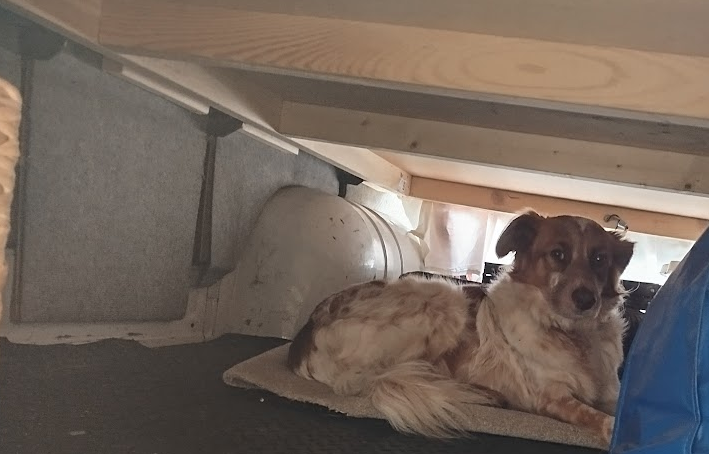

The van urgently needed some quick-access storage and a bit of workspace. I already had a tiny computer desk, a tatty bedside cabinet, a lightweight slim table, and 8 square baskets (5 of them dating back to my original 2017 van). 3 fit under the edge of the bed (leaving a generous gap for Kim to get in and out), 4 in the shelves of the computer desk. One is tucked next to the sliding door as a temporary lined bin, and may stay there, it works. (Like every other camper, I keep a bigger rubbish bag tied outside). The desk, cabinet, and table were sanded down and painted in the same soft neutral grey as the carpeted sides. The first two are now securely wall-hung on lift-off brackets, and the hideously inconveniently-placed leisure battery could be moved, without rewiring, to fit snugly out of the way under the smaller unit. (The leisure battery runs the TV and the built-in lights, I haven’t asked it to keep the cooler-box fridge going overnight, I have no idea how old / enfeebled, or indeed how powerful, it is.)


That wasted space inside the backdoors has become my favourite spot in the van: a baby mattress turned it into turned it into an ideal place to sit with morning coffee admiring the view. A back porch is not usually incorporated into a van design, the luckiest repurpose of all! Since this photo I have cut up and upholstered an old foam mattress to make a rather more conventional seat, as my visiting granddaughter occasionally needs the cot mattress.
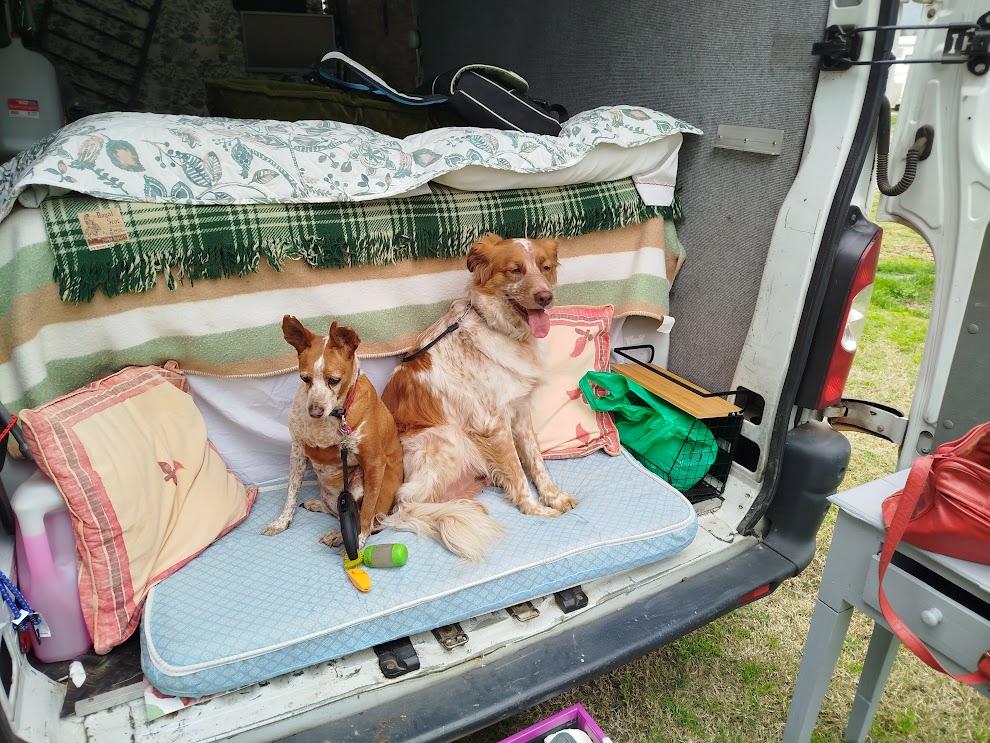
My coffee and breakfast spot, when the dogs shift up a little

The lightweight (3 kg) slim table has become the hardest-working item in the van – overnight it clips into lift-off brackets on the bed frame, becoming an eccentric headboard with its 2 little drawers ideal for phone and torch, current book, and stopping my pillows going AWOL into the back porch. During the day it either moves outside as an al fresco table for meals, or inside as a laptop desk, or even as extended ‘kitchen’ workspace. I took the van away for a trial weekend to nearby Orgiva to escape a noisy fiesta in my village and was thrilled to find every change made so far has made it extremely user-friendly. Quirky, granted, but the dogs love it and it was unexpectedly comfortable. Even my eccentric ‘en suite loo’ worked out perfectly overnight and of course at a campsite loos, showers, sinks for washing up, and even washing machines, are all included. I’d cobbled together hasty blinds for the first weekend at Trevelez and this time experimented a bit more – some had magnets, some had plastic suckers. The very cheap windshield shades should be avoided, by the way, they start to disintegrate as soon as they are cut. Aluminium bubble-wrap, especially the thermal stuff, lined with fabric for internal appeal, was the most successful, although it is too thick for the magnets so the inside fabric has to be large enough to cover the metal window frames. I’ll stick with suckers going forward, although the magnets are really useful for quick-fix fly / shade netting.
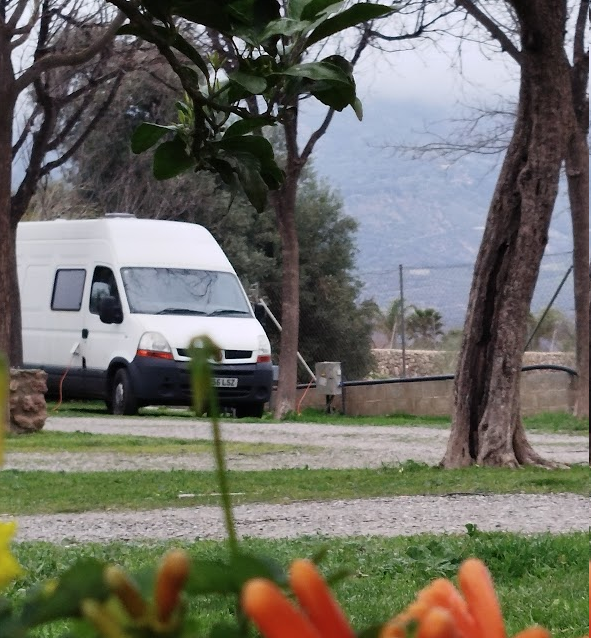
Big thumbs-up to Camping Orgiva, dog-friendly, in particular a huge meadow where they can run off-lead. They are welcome everywhere on-lead

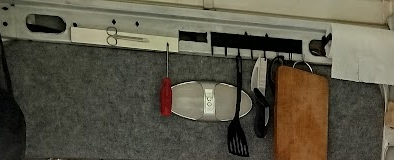
The ceiling has now had its first lot of insulation, professional aluminium-backed stuff bought by the roll from Amazon. I’m planning to add more recycled ceramic foam stuffing (I tried for the recycled plastic bottle stuff, surprisingly difficult to source in Spain) before fitting ceiling panels. All the little nooks and crannies also have to be stuffed – the first 5m roll was delivered yesterday, because, unfortunately, best will in the world, repurposing and upcycling can only go so far, some stuff does have to be bought. The first trial batch of 4-way-stretch carpeting has just arrived, as I was typing this, because things like the wheel and ceiling arches have still to be insulated and carpeted. (Not sure yet about the actual ceiling panels, and risking turning the whole space into a furry grey womb, hence only a trial pack). The van has, of course, metal reinforcing struts running round the sides at around head level and I went a little overboard on magnetic racks, shelves, knife holders, kitchen roll holders, battery-operated lights, and rechargeable USB lights. (There are lights built in, and running off the leisure battery, but I like to read at night and now have 3 different sources of light, nice.) There’s therefore no way I’m covering those handy struts but they will be stuffed with insulation and, because they are shabby and a bit battle-scarred, repainted. Not grey. I have a soft green metal paint in the storeroom already (re-use, re-cycle, re-purpose). There’s a lot of interior decorating to do, aligning and coordinating some very random items in very random colours.
The next expense will be gas struts for the bed, so that I can get to that massive additional storage without leopard-crawling under there, or having to find someone to help lift the bed. All this of course means I am heavily reliant on the friend Nick who did most of the work on my house refurb some years back and has remained worth his weight in gold and coffee ever since for maintenance and upgrades and, now, helping with van conversion. I dream up what I want, he tells me it won’t work, sometimes he’s right and I have to rethink: as in 2017 with the Casa Excéntrico, as in 2025 getting sorted in PP4, as now. He doesn’t approve of the van because there’s no chance in hell of that DVLA re-classification on my revised budget-driven layout, but he’s prevented some expensive mistakes. We’re arguing about the gas struts. A lot of the planning is designed to keep the van dual-purpose: the bed lifting up, the lift-out cabinets, even the removable magnetic fittings. I’m not intending to move house again but the van was priceless for the last move, and who knows when it may have to temporarily revert to hauling around furniture and boxes? It can.

Another expense I’m debating is more of a luxury, a power-pack to run the cooler-box fridge, laptop, electric kettle, and keep all the rechargeables recharged, so I can occasionally skip having to go overnight to a campsite. There’s a bewildering variety on offer, some available with mobile solar panels so one can park in any shade available, but have the panels in the sun. Research is ongoing.

Tick-tock as the extremely noisy annual Moros v Cristianos fiesta happens mid June and the dogs have to be removed from all the muskets, cannons, and fireworks for 3 to 4 days.

Such fun!
That #siesta van – conversion in progress, first to motor caravan for reclassification

Yes this has taken a while to update. Stuff happened – August is a VERY hot month in Spain, when life slows down and I was already not accomplishing much (or even attempting to, it is REALLY hot in August) when I suddenly sold my house and had to buy another and move within weeks: Things got really hectic and suddenly it was November and the MOT was expiring on 2nd December.

What I had learned in the meantime, which may help anyone looking at buying a right-hand-drive van to convert and use in Spain, is that it isn’t possible to get Spanish plates on a RHD van. What IS possible is to attempt to plate a RHD motor caravan. You have to have owned it at least six months, and it will still have to get through the Spanish test for roadworthiness (matriculación) (which will be very strict, because they really don’t want them here) to even be considered and because by definition it has a big engine, there’s a hefty chunk of duty to pay if it does, but it can be done.

Another thing for any British person with a Spanish driving licence to bear in mind is that even if you are still British by citizenship, Spanish only by residency, you are only allowed to drive a UK vehicle for a month in Spain before it must be plated. Slightly confusingly, the vehicle itself can be in Spain for up to six months before it must be matriculated.

So – the sensible thing to have done was to sell it back to the UK while it still had a few months on its MOT. However if you really think your van is worth a significant amount of trouble and expense, and your dogs love it, you can reclassify it and find an agent who specializes in plating UK vehicles and cross your fingers and go for it. I should have been sensible and this is not yet a success story and never may be, but it is a record of the next few steps.

I’m told the DVLA requirements may be changing soon but right now, at the time of this blog, the requirements to get your van reclassified as a motor caravan are actually not too challenging.

Externally, it must be recognisable immediately as a motor caravan, which effectively means it needs an awning rail either side, and suitable decals of your choice either side which declare it to be a recreation vehicle. This does remove the stealth option – where a van can park pretty much anywhere overnight and pretend to be empty, a motorhome can only park in appropriate places. The van must also be high enough for an adult to stand upright inside, and have at least two windows in the habitation area.

Internally, and as I mentioned this could be changing, it needs to have fixed seating in the habitation area, a fixed table which can be removed or adapted, and fitted sleeping arrangements, which can be converted from the seating / table. There must be at least a single-plate cooking facility built in, or microwave, and there must be storage facilities. Any gas supply must be correctly secured. Photographs showing all of the above, and the registration number, and the VIN or chassis number, must be sent to the DVLA along with the request for reclassification. They can, be warned, reclassify it as, say, a van with windows (and that decision is final) and / or they can insist it be presented at a suitable testing facility for inspection. This is all on the Gov.UK website – https://www.gov.uk/government/publications/converting-a-vehicle-into-a-motor-caravan/converting-a-vehicle-into-a-motor-caravan – and presumably the link stays the same if/when the requirements are revamped.

I took the van on a camping excursion during that first legal month and remained thrilled with it (we’d also had a successful trip from UK to ferry to Santander to home in the south of Spain) so I started on the conversion. It had to be stripped of some hoisting equipment (long story), the floor was sound but very scuffed, the previous owner had stripped out the ceiling insulation but the sides and doors had been professionally done and were still good. But tick tock – MOT running out 2nd December. The agent specializing in UK cars said he could get the van green-plated for up to six weeks, which would keep it legal long enough to reach the required six months of ownership (4th January) but it would have to be converted, reclassified, and the new V5 received, by then. DVLA was almost certain to demand an inspection seeing the MOT was imminent anyway, and as they frown on vehicles being taken out of the country ‘unofficially’ there could be no pleading that it was in Spain and an inspection would be seriously inconvenient.

As matters stand, the interior is largely completed to the “siesta van” minimums . The exterior requirements are not. The decision was, if it must be sold, to keep it in stealth mode until everything else had been done. In the UK, the only advantage to being reclassified is to be allowed to drive slightly faster on the motorway than is legal in a commercial van. Stealth mode is an asset to many, silly to lose it for what was still a very basic conversion.

Anyway, those are all fairly unique situations arising from owner stupidity so the only other thing this blog warns about is insurance. I got Spanish insurance from a broker specialising in English-speaking clients living in Spain but they are only the brokers. My advice would now be to get UK insurance for that first six months, which is what I had originally done with my car when I brought that to Spain. The van is on its way back to the UK with long-suffering friends to get its MOT sorted, but blotted its copybook very much indeed by dying in France. Untangling the situation with Spanish insurers and French garages is beyond frustration. Don’t do it. I’d also say in passing that if my brokers had only said (or even known) it wasn’t possible to register a RHD commercial vehicle in Spain this blog would never have been written and I wouldn’t have a dead van in France. This has been a series of stupid blunders from the beginning, though.

I can only say it seemed a good idea at the time. I drive a RHD car (legally) so am probably marginally less lethal in a RHD van than I would be in a LHD. I have a very young granddaughter in the UK so the notion of escaping the excessive summer heat every year by meandering across Europe with bag, baggage, dogs, and my own accommodation, to call on scattered family, was fatally tempting. Meh.

There’s no law that says you have to make your own mistakes, you can learn instead from others, so there may well be more blogs on the nature of this rather focused ignorance for any other unenlightened out there.

The #siesta van

Back in 2017 I needed to get from Scotland to Spain, with boxes and pets. Camperhomes, even before the popularity surge caused by Covid, were alarmingly expensive. I chased up a cheap van in Glasgow because I couldn’t understand how it could be so, well, cheap. The seller described it as a day van, a bit apologetically. I looked blank and he said well, a weekend van. Or an event van. He took his, he said, to dog shows.  You couldn’t LIVE in it.  

I did, for 8 weeks, but because I was travelling alone I was staying at campsites anyway: loos, showers, and washing machines were part of the campsite package and so far as transporting me and my pets and several boxes of needed-on-voyage stuff went, it was perfect. I miss it so much that I started looking for another this year. Day van is not a known description in Spain (not that well known in the UK, for that matter) but although they have lots of the type, there’s no other name, either.  I tutted at myself and tried siesta van, which seemed the obvious Spanish name. Nope.

We’re talking about a van without built-in plumbing, really, although the definition is fairly fluid. It has a bed, and a fridge, those are important, and a leisure battery with at least one plug point. Talking of plug points, it should link to campsite (or dog show) electricity points, then you aren’t relying solely on the leisure battery. Cooking facilities are usually camping type. A porta-potty – maybe even a mini sink with a foot-pump and bottles of water  (well, mine did) but not a shower.  Not a lot of fancy. “Siesta van” works for me. Time to get the name out there, to help me search …

Insulation would be a definite plus, on my check list. Having windows, big yes, and a skylight, bonus.  I can source my own portable toilet if there isn’t one. Adding a sink and hot water and a water pump, yes worth having – eventually if not immediately. But basically a van that supports your hobbies, and interests, keeps you comfortable and secure, gets you there and back, has a little comfort for excursions.  

Don’t get me wrong, not dissing those motorhomes which cost more than a holiday apartment – what can be fitted into those is eye-popping, if sometimes a little cramped. The features you get! The price you pay!

·         I don’t need solar panels and storage batteries and inverters and fancy dials to monitor them, because I won’t be going off-grid more than my leisure battery can handle.

·          I don’t want a shower. I love showering, the longer the better, but to meet my shower needs a van (or motorhome) would have to drag its own water tanker around.  Most on-grid campers I’ve spoken to don’t use theirs – they’d rather grab their flip-flops and go use campsite ones, or gym ones, for exactly that reason. So the fab shower which pushed their camper price up by thousands is often just a fancy cupboard, or a place to hang wet clothes.  

·         The ability to sleep several people of differing sizes, don’t need that.     

·         Enough storage to have every season’s wardrobe on tap, well, uh, no. I go home between excursions.

Paying for those, if you need them, no-brainer. But perhaps you, like me, only need a bed. And blackout blinds. And room to store a bit of food, and some changes of clothes. A 3 way fridge – nothing worse than waking up all hot after a siesta and nothing cold to drink.  We’re not living off grid for six months at a time, it can be pretty simple. I don’t personally need a bike rack, or to store surf-boards, but some vans have them. They’ve got the space – because they didn’t  waste space on a shower –  

I thought I’d found just the job, but I found it in the UK and brought it to Spain and, well, that’s causing issues. I’ll probably blog a bit about the learning curve because then maybe people will chip in with ideas of the must-have features for the perfect, ideal, budget-friendly, siesta van. Deal?